
Cooking with Legends: Ming Tsai and Rick Bayless
2/27/2026 | 56m 56sVideo has Closed Captions
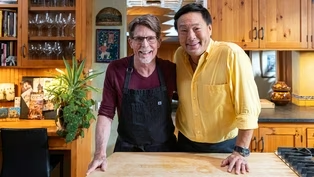
Grab a seat at the table with these award-winning chefs as they share favorite recipes and stories.
Grab a seat at the table with these two award-winning chefs as they share recipes and dish on their inspirations. Join them on a field trip to Chicago’s Lao Peng You for dumplings and to Rick’s restaurant, Frontera Grill, for cocktails and stories. Ming’s son, Henry, also joins in the festivities, as they all share childhood recipes they still eat to this day.
Problems playing video? | Closed Captioning Feedback
Problems playing video? | Closed Captioning Feedback
Cooking with Legends: Ming Tsai and Rick Bayless
2/27/2026 | 56m 56sVideo has Closed Captions
Grab a seat at the table with these two award-winning chefs as they share recipes and dish on their inspirations. Join them on a field trip to Chicago’s Lao Peng You for dumplings and to Rick’s restaurant, Frontera Grill, for cocktails and stories. Ming’s son, Henry, also joins in the festivities, as they all share childhood recipes they still eat to this day.
Problems playing video? | Closed Captioning Feedback
How to Watch Cooking with Legends: Ming Tsai and Rick Bayless
Cooking with Legends: Ming Tsai and Rick Bayless is available to stream on pbs.org and the free PBS App, available on iPhone, Apple TV, Android TV, Android smartphones, Amazon Fire TV, Amazon Fire Tablet, Roku, Samsung Smart TV, and Vizio.
Providing Support for PBS.org
Learn Moreabout PBS online sponsorshipAre you ready?
- Oh, my God.
My mouth has not stopped watering.
- Smells so good.
- That smells like my childhood.
We haven't had a bad bite here.
- We haven't even had a mediocre bite.
(both laughing, cheering) This makes me happy.
- If I was James Beard, I'd give you an award right now.
Just like that.
(snaps) (ice rattling) Hi, I'm Rick.
- And I'm Ming.
BOTH: And this is "Cooking With Legends."
- Cheers.
- Cheers.
- This is gold.
- It's fun cooking with you.
- I now know why you are you.
♪ ♪ Thank you for having me, I'm so honored to be here.
- Oh, my pleasure.
- And I can already smell something on the grill.
(laughs) - Yes, you can, yes.
- First of all, Rick, your house is unbelievable.
- Oh, thank you very much.
- I mean, it's, it's, it's like a museum.
- It is a little bit like a museum.
- Right?
I mean, literally, you have stories everywhere.
- Every little area of this room, especially, you'll find something that has to do with my and my wife's history.
So it's not like we hired a designer and put it all together-- it's just things that we've collected through the years.
- Oh, no, it's so personal.
You can tell, everything you hand-picked.
It's fantastic.
- Yeah.
- You know, Rick, we've known each other so long.
We have very similar history.
Yeah.
My first professional job, I was probably, like, 13, but I've cooked since I was probably ten.
And I think you cooked before that, even, no?
- Well, I grew up in a barbecue restaurant in Oklahoma City, and I just loved it.
- What was that called?
The Hickory House.
- Okay.
I was there for 37 years, and I just loved being out there from an early age.
I think it was like, seven, I started going out and hanging out all day.
All the cooks would give me tasks to do.
They taught me how to be a professional cook, because we had to sell this stuff.
They would show me exactly how to make it, and it had to be done this way... - Right.
- ...because that's what our customers were expecting.
When I could stand, so I'm two-and-a-half, three years old, I would hang out in the kitchen with grandparents or parents, fire, smoke, but most importantly, the snacks.
They would throw you a piece of duck... (laughs) - ...or a piece of this or a piece of that.
Yeah, yeah.
- And I never left the kitchen.
I was so fascinated by the fact that all these weird ingredients get put together, and, food.
"This is the coolest thing ever."
Now, where was that?
- We lived in Dayton, Ohio.
My mom opened the Mandarin Kitchen.
- Oh, okay.
- My dad, who is still alive, 96, he was chief scientist at Wright-Patterson Air Force Base.
My mom was a great home cook, did cooking classes, kind of like you did... - Yeah.
- ...and was urged by everyone and her friends, "You should open a restaurant."
So I'm ten years old, this is 1974, and every Chinese household has leftover rice.
Of course, you have garlic, ginger, and scallions.
Chopped everything up, put it together.
Honestly, it was like a five or six out of ten quality, because I, I put a little too much soy sauce, because I'm ten.
But I served it.
And you know this better than anyone.
They looked up and they smiled.
- Yes.
- And I'm thinking, "Wait a minute, I can make something that can make people happy?"
- Yeah, for sure.
- "This is something that actually I like to do "and I'm pretty good at it.
And this is probably what I'm gonna be."
At ten, I knew it.
That is exactly what I fell in love with in my parents' restaurant, was seeing all the smiles on everyone's faces.
So I'm gonna make for you the real specialty of my family's restaurant, which is hickory-smoked ribs.
Now, when you say "Oklahoma barbecue," a lot of people don't quite know what it is, because it's not Texas barbecue and it's not Kansas City barbecue-- two very well-known.
- Right.
- But it draws from both of those traditions.
And like Texas barbecue, it's dry-rubbed and let cure for one to two days, and then slow-smoked, but not with mesquite-- with hickory, the way they would do it in Kansas City.
I can smell them-- I can't wait.
♪ ♪ - These are back ribs here.
- Beautiful.
- You can do it with spare ribs, as well.
- Right.
- And we did both at our restaurant.
So I'm, I'm working with the back ribs here.
- Okay.
- But the first step, of course, is to do this dry rub on them.
And I'm going to show you what we did, how we created that dry rub when I was growing up, but... - I can help.
Mince it up?
I need that as fine as you can get it.
You want to make it a paste, okay?
- Got it.
- And so here I've got two different kinds of chilies.
This is guajillos and anchos, both going in there.
You might think that when I was growing up, we didn't talk about anchos and guajillos, but we bought that mix already made.
- Interesting.
- And I found out later in life, "Oh, this is the stuff I work with all the time."
- And 50-50, or do you like more of one... - 50-50.
- Okay.
- The guajillos give you bright flavor and the anchos give you sweet, dark flavor, okay?
So I have salt and I have sugar here, some thyme, Mexican oregano, and black pepper.
And I'm just going to pick all of this up and dump it in together to make this spice rub.
I like both salt and sugar.
That's what I grew up on.
And it also, the sugar helps to color everything in the, the ribs when they're cooking there.
There you go.
- Very good.
Thank you.
- I like the looks of that.
This, by the way, is something that you can store for a long time.
I like to actually store it in the freezer just to keep it fresh.
And if you are one of those people that likes garlic powder, you could do this with a good garlic powder instead of the fresh... - Yeah, but the oil matters with the garlic, but... - I think so, too-- I like it the best.
And while you're doing that, I'm going to make this sauce.
I'm going to put some ketchup into a saucepan here, and then I'm going to add some of that rub.
Now, I made some rub ahead of time, because, to tell you the truth, I'm having these this weekend, but I already rubbed some so that we have some to go ahead and put out on the smoker.
- Because you, you let them sit for 24 hours or 48?
At least 24 hours, but I prefer to do it two days ahead, so for 48 hours.
And that goes in here.
That's one of the flavors.
I like a very peppery barbecue sauce.
So I've got some fresh ground black pepper that's going to go in there, and then the flavors get very deep with Worcestershire sauce, so that's going into the pan, as well.
And a little extra vinegar that is balanced with brown sugar, okay?
So this is a sort of sweet barbecue sauce here.
- And this is what you made at your restaurant?
- This is what we made.
- This sauce?
- And we just simmer it for some time until all the flavors kind of come together.
And I'm going to put this now over about a medium heat and just let it simmer for a while.
I like to simmer it for about an hour at least, but if you have a low fire and let it go for a couple of hours, I think it's even better.
One last thing that I have now is, since you're so good at garlic, would you just chop that all up?
- (laughs) Sure.
- And one of the things that I do here that is not something that I did growing up is, I use black garlic.
It's got such depth of flavor and sweetness that I really like it in this barbecue sauce.
But I will tell you that it thickens in a very different way.
So if I put it in at the beginning, it, I get this super-thick sauce.
So if I'm going to use black garlic, I put it in right at the very end.
That's great, thank you very much.
Right into the pot and stir that.
I'm going to go get the ribs that I have already dry-rubbed and let sit over almost 48 hours now.
And we'll put those out... - Let's have a look.
- ...into the, into the smoker.
- Awesome.
Can't wait.
- This is a Hasty Bake grill made in Oklahoma just for making these kind of ribs.
It's got a firebox in the bottom, and you can raise and lower it to control the temperature with it.
So it's a pretty easy thing to work with.
If I can ever get these gloves on.
- I'm glad you're not my surgeon.
(laughing) - I'm sorry... Yes, exactly.
These are so big.
- They're huge.
So, vertical cooking.
- You can get more on here.
- Okay.
- And usually, when I'm making these, I'm making them for a big crowd of people.
- Got it.
- And so I can do about eight racks.
- But you also don't have to fuss with it.
You don't have to flip them.
- You don't have to flip them.
You don't have to worry about uneven cooking or anything like that.
I want to keep it at around 225 to 250.
And then two-and-a-half hours is usually the amount of time... - Two-and-a-half.
- Yeah, it's a sort of slow cook.
- And you can just, just set it and walk away.
- Walk away.
I mean, you got to come back and make sure the temperature's right, that's all I can say.
- But slow... - But it's... - Slow, 250, slow.
Two-and-a-half.
- Slow, and just let them coast along.
And then they're going to be delicious.
- I can't wait.
- Well, at least I've got my fingers crossed they're going to be delicious.
- They're gonna be delicious.
Let's go inside, because it's freezing in Chicago.
♪ ♪ - That's what I grew up with.
- Nice.
And I will say that it wasn't until I was about 14 years old that I learned that all of my clothes smelled like hickory smoke, because that's what we did.
We smoked meats, and the entire restaurant smelled like hickory smoke.
And so did my closet.
That's hilarious.
- Okay.
(both laugh and exclaim) Let's look at these beauties.
- Look at those bad boys!
- In the tradition that I grew up in, sauce doesn't play a major role in it, but you could put just a little bit of sauce on here as a kind of glaze on it.
But to tell you the truth, it doesn't really need that.
But I'm just going to give it that little bit of flavor.
But look how beautiful they are.
- It does, yeah.
This is camera-ready now, right?
That little glaze.
- Okay, that's right.
- And my mouth is literally watering.
- Good, good, good, good!
I'm glad to hear it.
Okay, we're going to close it up for just two minutes, just to set the glaze, and then we'll take them off.
- I can wait.
- Okay.
- Barely.
♪ ♪ (Ming chortling) - We're getting to the payoff here.
- I mean, it looks like the Asian barbecue right there.
- It does!
It really does!
Okay, let's go back in.
- All right, let's go eat, man.
Let's go.
- Are you ready?
- Oh, my God.
My, my mouth has not stopped watering.
- Yeah-- you know, what I really love about this is, when you're working with hickory smoke, or any kind of smoke, you get that beautiful pink color.
- Look at that.
- I just think it's so beautiful.
- That is so beautiful.
- Come on, dip one in.
- All right, let's go.
- Yeah.
- Let's go.
- Yeah.
Mm.
- Oh, my God.
- I, I think they're good, if I do say so myself.
- No, they're not good, dude.
- Oh, my God.
- They are, they are tremendous.
Perfect amount of smoke-- you're so right.
You taste that hickory, which is so different than so many other smokes.
And I do it very light-- I don't want this... - No, it's not crazy-smoky.
- ...overly smoky.
Wow.
But the tenderness is absurd.
I mean, you're talking about fall-off-the-bone.
- Yeah, but there's some meatiness to them, too.
- No, there's still a bite.
Yeah, they're not, like, braised and just soft.
- Yeah.
- But you're so right about the pinkness that gives you that structure to the meat.
- Oh, it's so good, yes.
Whoever thought the foremost Mexican chef in the country makes awesome hickory ribs?
- (laughs) - That's... - This is, this is where I started out, was with these flavors, and they're bold, and they're really satisfying.
And so when I got to Mexico, I found food that was bold and satisfying, so it was a natural progression for me.
- And you never thought of somehow blending hickory smoke... How about... - Mm.
- ...a rib, a Mexican version of a baby back?
- You know what?
I'm gonna invite you over, and I'm gonna make this fusion food for you.
Okay?
- I appreciate that.
No, but this is ridiculously good, dude.
I know what I would do, too.
- Yeah?
Because this is sort of sweet.
- Yeah?
And not too many sauces in Mexico are very sweet.
- Right.
- But I know a mole that would be a great basting sauce for this.
- Yeah, exactly.
I could do it, but only for you.
I will be waiting.
- Okay.
Just, you can't get this at Frontera, sorry, guys.
I'm loving this so much, I can... Now I can't stop talking about it.
I think we're just gonna eat these.
Rick, this is why you're a master.
Cheers to you, santé, cheers.
- Anyway, cheers, yeah.
- I'm cooking also a pork dish.
Literally grew up cooking this with my grandparents and parents.
We served it in the Mandarin Kitchen, called red roast pork.
So it's pork shoulder or pork butt that we literally braised for three hours.
But it's soy sauce, red wine, it's star anise, cinnamon... - Oh!
- ...garlic, ginger, chilies.
And you lightly braise it with the fat cap on, right?
Because the fat's in that-- we get it all shredded.
And I'm gonna serve it with something I used to make all the time, which are scallion pancakes.
Oh, one of my favorite things in the world.
- And I want to show you the way that my father and grandfather taught me.
Like, the memories back in Taiwan and in Dayton, Ohio.
Rolling scallion pancakes for the masses, and, so... - I want to learn that technique, because I've never mastered it to the point that I, I felt really confident in it.
And I can't wait for you to show me that part of it.
- It's actually quite easy.
♪ ♪ I am so excited to make you my red roast pork dish that my grandfather showed me.
This looks just amazing here-- I'm very anxious to learn.
And for the record, I need to introduce you to my son Henry.
Henry, welcome!
- Hello, Rick.
- I don't know if you've ever met.
Who is a good little cook himself.
So the red roast pork is my dad's favorite.
My grandfather taught us how to make it.
It is basically all these ingredients, that all goes in.
We braise that beautiful pork butt or pork shoulder really slow-- three, three-and-a-half hours.
You can use a pressure cooker for an hour, all right?
- So it's just fall-apart tender.
- Exactly, so, you're my sous chef.
If you could give me some scallions, green slices, and then I'll take, like, two-, two-and-a-half-inch whites.
That's going to go into my pot.
- Okay, cool.
MING: Henry's going to make the hot water dough, Rick.
Hot water dough is the master dough where you make all dumplings and all scallion pancakes.
RICK: Okay.
MING: It's the easiest dough in the world.
Thank you very much.
MING: And then I'm going to start building this braising liquid.
(mixer whirring) That was the soy.
Here's the great flavor-- star anise, two is plenty.
Thai bird chilies and cinnamon.
- Cool.
MING: Rock candy is the traditional sugar.
RICK: Yeah, that's what I thought-- I'd heard that before.
MING: But sometimes, you can't find rock candy, brown sugar works just as well.
- Okay, okay.
- Right?
And you think it's a lot-- it is a lot.
But you need that, because the sweetness of the sugar will bring out all the, all the wonderful sweetness of the pork.
A couple ginger slices.
- Okay.
- I'm gonna halve this garlic.
RICK: Okay.
MING: Again, everything goes right into the braise.
Just, like, quarter-inch slices.
- Okay, now, you don't peel this?
- No, it's just washed.
So in Chinese cuisine, you only peel ginger if you're gonna eat it, meaning ingest it in a stir fry.
- I see.
- But in a braise, the peel is fine, right?
- Got it.
(mixer stops) MING: Want to make sure the sugar gets dissolved.
RICK: Yeah.
HENRY: Here, chef, what's the consistency we're looking for here?
- Yeah, yeah.
Keep this going low.
(mixer whirring) Lock it down.
There we go.
Yeah, keep going nice and slow.
Yeah, there you go.
That's good-- let it work.
So here, we just make a ball, and you knead it... It's just kneading, right?
The dough hook is a great, great way to help knead.
And you got to go for about eight minutes or so.
- Oh, okay.
- And the key is, once it becomes a ball, you knead it then by hand.
RICK: Uh-huh.
- And then let it rest for an hour.
RICK: Oh, okay.
Okay?
So you got eight minutes.
So this is good, you're gonna take this whole pork butt.
Just lay this in here.
Oh, yeah.
So now we're gonna bring this to a simmer.
RICK: Yeah.
MING: And we're not gonna touch it.
So we're gonna let this dough come together, knead it by hand, and then when we come back, we're gonna have the dough rested, and we're gonna make scallion pancakes... - Okay.
- It's just like a tortilla.
- I... Not exactly.
- Yeah, I don't think... - It's not even close to a tortilla.
- But I'm gonna say, I'm super-excited about that, because I love eating them, but I don't know how to make them.
All right, so here we have the dough that's been rested.
- Okay.
- Right?
Which I love.
Feel that-- it's pliable, it's soft.
RICK: Ah, yeah-- kind of Play-Doh-like.
- Yeah, a little bit-- so, a little bench flour.
The key is, get this as thin as you can possibly get it.
But the thinner this goes, the more layers you'll make, right?
So go nice and thin.
Gotta use a little elbow grease-- get it out.
All right, as you guys are doing that, grapeseed oil with a little sesame oil.
Some chefs use straight sesame oil-- I find that's too strong.
- Too strong?
Yeah, I believe that.
- Right?
So just a touch of sesame oil.
Chef, you're gonna take this oil and you're gonna go all the way to the edges.
RICK: Okay.
- Just like that, okay?
- All right.
- And then I'm gonna take a pinch of salt.
Season it like it's a steak, right?
RICK: Like a fair amount?
MING: Yeah, yeah, like a steak, right?
Because dough has no flavor, and good amount of scallions, right?
It's a scallion pancake.
You want to be able to taste the scallions.
RICK: Okay.
MING: Right?
MING: So Henry and I probably... Henry, how old were you when you made the first scallion pancake?
You were... Probably around 12, 14.
Oh, you were eating them since you were four.
- Eating them since I was a child, yeah.
- Before I can even remember.
- Okay.
How's that?
MING: That's perfect.
Now, take the closest edge to you and roll it.
- Okay.
- As tight as you can.
- Tight.
- Right?
And don't force it, but just roll it.
So here we're creating layers, right?
RICK: Yeah.
HENRY: I remember you had a scallion pancake phase where you were trying to find the ultimate layered lamination.
- Oh, and my grandfather used to take cooked hamburger meat with garlic and ginger and put it in, and then roll it.
- No!
- Oh, it was so good.
Grab both ends and just twist it twice.
It just creates a little bit more lamination.
RICK: Like that?
MING: Yeah.
Then I bring this end, and you roll it into itself.
RICK: Yep.
MING: And then this end goes underneath.
And now push this out.
Use your same rolling pin.
RICK: Oh, wow.
MING: And go nice and soft-- don't go too hard.
And if some scallions come out, that's okay, because those scallions get charred on the griddle, so it's actually, makes it tastier.
And here you don't want to go as, quite as thin as before, because it'll be too thin, but you want to go to about a quarter-of-an-inch.
RICK: Wow.
MING: Yeah.
Looks good.
It's kind of just like a tortilla, except not at all.
- Except not at all!
(all laugh) Wrong flour, wrong oil, wrong vegetable.
MING: I can't, I can't say to Rick... This has flour in it, so that's the only similarity so far.
MING: And salt.
Okay, that looks great.
So just a little grapeseed oil on the griddle.
And you can just get your pancake on that.
Oh, that looks good, Rick-- here, put it right here.
RICK: Okay.
Looks good-- all right, Henry, let's do yours.
HENRY: We're going for the Smashburger principle right here.
- That's all right.
I like it-- yours is actually the biggest one.
All right, so it's key-- don't touch it.
Let it get crispy and brown.
About two-and-a-half, three minutes, right?
- Ooh, beautiful.
MING: Oh, look at that.
- Smells so good.
- That smells like my childhood.
That smells like my childhood right there.
Look how these scallion pancakes look.
- I think they look just great.
MING: What do you guys-- a little seasoning on that, Henry?
So, like, french fries, salt has to come out.
RICK: Yeah.
MING: There's another one.
Season that, buddy.
- Come on, a little more salt.
- A little more salt, all right.
- (laughs) - There we go.
- Okay, all right.
- Okay, that's there.
- Rick, give me a hand here.
- Yup.
I am in position to catch.
Nice, nice, nice.
MING: Oh, yeah.
Oh, that looks incredible.
This is the fun part, this part here.
This you can just shred.
Here's all the pork fat, right?
We're just gonna take this, and take a scallion pancake.
Take a piece like this, gonna take a piece of this pork.
Gonna make yourself a little, I don't know, call it a something.
This is for you, sir.
- (laughs) Oh, thank you, I was ready to just jump in and do it myself.
MING: This pork fat here, this is like Chinese foie gras, right?
It's so rich and so luscious.
- It's good-- hot, but good.
- Mm-hmm, mm-hmm.
This is why chefs have asbestos mouths.
No, but it's so good.
All those flavorings in the pork are amazing.
And I really like these pancakes.
They've got all that lamination that you were talking about, those layers.
And I love the scallion in there.
It's super-good.
And the go-to move is right there, the sauce.
That's our consommé right there.
- Mm-hmm.
So this will feed your family.
And the next day, cold pork sandwiches.
And then the third day, fried rice with red roast pork.
On and on and on and on.
- This is gorgeous.
- And whole duck works just as well.
RICK: I would like that, too.
MING: Mm, mm, mm.
And so did you guys have sambal in the house?
- Oh, yeah.
I'm not sure we had ketchup.
- (laughs) - No, honestly, we had more... - I grew up with ketchup.
You grew up with sambal.
- I had sambal, three different soy sauces, vinegars-- all the Asian stuff.
- Green cap sriracha.
- Yeah, sriracha.
Exactly.
This is really amazing, but I have to tell you that I have this amazing family-run restaurant that I think makes the best dumplings in this town, and I'm gonna take you there.
- Love it-- let's go.
- Okay.
- Sounds good.
- Right now.
♪ ♪ DANIEL WAT: We make our dumplings here in the restaurant.
Every single dumpling is rolled by hand.
It started with my nai nai.
She really made us amazing food and taught us how to love people through food.
DANIEL: We would make dumplings together and we would make endless amounts.
Such a wonderful experience growing up.
♪ ♪ Hi, I'm Eric Wat.
I'm the chef-owner with my brother at Lao Peng You.
People all call me Chops, though.
I'm Daniel, co-owner of Lao Peng You with my brother, Chops.
♪ ♪ The ability to share our family with the city, with Chicago, with our friends, it's just a blessing for us.
Having Rick Bayless and Ming Tsai come into our restaurant to eat with us and to be able to show them what we do is such an honor.
We're gonna have a good time.
We're gonna have a good time.
ERIC: So this is our pork and chive filling.
This is really our most popular dumpling by a long shot.
This is the closest to what my nai nai would make when I was a kid.
And so this is really something that we wanted to honor her by making the pork and chive jiaozi.
I think you and lots of us have honored our nai nais making dumplings.
(laughing) RICK: You gotta show me!
I do not come from the tradition of making these.
DANIEL: Yeah, this will act as a little bit of a glue.
You'll want to fold it, create a seal at the top.
RICK: Okay.
Got that.
And seal all the way around.
RICK: Uh-huh.
DANIEL: Hopefully, one of these days, we'll have these bagged in grocery stores.
You're going to have to have a bigger table, with more people.
(laughing) That's all I can say.
ERIC: She didn't teach us how to cook.
Sometimes she would, like, give me a couple pointers here and there, but she always told me, "If you know how to do what I'm doing, you would no longer need me."
She would shoo me away from the kitchen, and I would have to watch.
And a lot of these recipes are based on the memory of smell.
So, okay, look at mine.
MING: Oh, I see.
- And is that what it should look like?
Uh, close-- yes, close.
You're getting there.
- That was not affirming!
(laughing) RICK: So one day a week, you're just doing prep for the rest of the week.
DANIEL: Three days a week.
MING: Three days a week.
Those three days you're doing prep work.
- Yeah.
- Yep.
Wow, that's a lot of dumplings.
About 15,000 a week.
15,000 a week.
- Yeah.
- That's incredible.
Scaling up to that point has been wild.
When did you guys open?
ERIC: So we opened... 2019, so six years now.
RICK: So you're coming on six years right now.
- Six years.
Congratulations.
- That's awesome.
- That, that is really remarkable.
- Thank you so much.
RICK: I'm ready.
- We're gonna cook some lunch for you guys, and we're gonna try a couple other things.
But let's take a look at the progress here.
Beautiful, honestly-- no, this is beautiful.
- Oh, thank you!
To have Rick Bayless dumplings, hand-rolled dumplings, here at La Peng You, we're honored.
- I rolled a bunch over here.
These are my dumplings there-- knock yourself out.
Yes, these are incredible.
- "Incredible."
- Incredible dumplings.
(exclaim) - Are you looking for a job?
- I am looking for a job.
ERIC: That feeling of being around the table, rolling, it's an extension of that experience as us as kids.
It's always come down to just doing it by hand because we love it.
(others exclaiming) RICK: Ooh, what do we have here?
Did I make those?
DANIEL: These are exactly the dumplings that you made.
This is so beautiful.
- Do you eat with your eyes?
- Yeah.
MING: This looks amazing.
The eggplant is tremendous.
RICK: It's spectacular.
- Thank you.
And it doesn't taste commercial.
It tastes like it's made with love.
Like homemade at a table.
- Exactly.
MING: We haven't had a bad bite here, right?
HENRY: Not a single.
RICK: We haven't even had a mediocre bite.
(all laughing) DANIEL: This is our home.
We are incredibly proud of this city, of our work, and we don't plan on going anywhere.
We plan on doing this for a long time.
Honestly, we love it.
MING: What was that one dish that you, like, when you opened up Frontera... As a little kid, I was very interested in other cultures around the world, and I spent lots of time in the library.
But instead of just general books on culture, I always went to the cookbook section.
I was really intrigued to see how different cultures expressed themselves through their food, and so I got the opportunity to go to Mexico when I was 14.
Literally, just fell in love.
I always say that I was there about three hours, and I said, "I've come home-- this is my place."
Decided to bring some little touchstone of that culture back to the United States.
And that's when we opened Frontera in 1987.
The thing was that everybody thought about Mexican food in the United States as just Mexican American food.
I do give a lot of credit to PBS and the fact that it gave us a platform to be able to teach and show authentic Mexican cuisine, how to do it, and it's actually not that hard-- authentic Asian cuisine.
To educate America was really probably the biggest benefit.
The comments that I love the most is, "I now cook Asian."
Or, "I now cook Chinese because of you."
I think we need to cook.
- Let's go.
♪ ♪ Okay, Ming, it's taco time.
- Yes!
- We're gonna do our steak tacos.
And the first thing that I need to do is to make a simple marinade.
And it starts with two-thirds of a cup of peeled garlic-- so, like, a lot of garlic.
- A lot of garlic.
- But the way that I work with it is to blanch it so that it, I lose some of that strong pungency.
- The super-strong, right.
- Okay.
So this was just one minute covered with water in a microwave, and that gives us... - The old Chef Mike blanching.
- The Chef Mike blanching, yes.
They love to work with Worcestershire sauce in Mexico.
- Right.
- They call it salsa inglesa.
English sauce.
- Is that what they, really?
- Yeah, and so I'm going to put some of that in there.
- Is that because they can't say Worcestershire?
- I can't say it, you know?
- None of us can say it.
- And then a little bit of soy sauce, which might surprise you.
- Soy sauce?
- They're, especially in the western part of Mexico, they use a fair amount of soy sauce.
And then this is black pepper, and then, it could be a big pinch of sugar, or I've got a little bit of agave syrup that's going to go in here.
- Nice.
Then we're going to blend that.
If you could do two teaspoons of salt in there, I'm going to glug in two tablespoons of olive oil into this thing.
- This is probably the first time in 30 years I've used a teaspoon to measure salt, to be honest.
- (laughs) Okay.
- You're a chef, Rick Bayless, and I don't want to screw it up, can't screw it up.
- We're gonna blend that until... - You can tell this is gonna be so delicious, with that much garlic?
- Well, that much garlic is gonna give it something special.
(whirring) Okay.
(blender stops) So that's really all that you have to do to it.
So we're working with skirt steak here.
If you could turn these over so that I can get some more of the marinade on it, as well, thank you, sir.
And then we're going to go over to this sort of Mexico City-style guacamole.
We're going to flavor this with roasted tomatillo salsa.
And it has a little bit of cilantro, but I think that a little extra cilantro is really good here.
- And this is from your garden?
Everything's from your garden.
- Uh, some of it's from our garden.
I can't grow avocados here!
- Okay, that's a good point.
- This is just a way of seasoning guacamole that is a little bit different.
But I find it... - You can smell the chilies.
- Yes!
It's a good thing-- well, we want this to be kind of spicy.
This is actually my favorite guacamole.
Why don't you cut that one up and I'll cut this one up?
A little over a quarter-of-an-inch slice.
- Just rings?
- I'm going to lay these guys out here.
Go ahead and just lay those there-- spray that... - Any salt on that, chef?
- Yes, please.
A little salt over the top of it.
This is simple cooking.
(sizzling) We're going to save some of that marinade to be a little flavoring.
- You need oil or not?
- Yeah, just on the, on the grill pan part of it, yeah.
(sizzles loudly) Okay, that's the sear and sizzle we want.
(sizzling loudly) - There we go.
- There.
- Move that guy down a little bit.
- (chuckling): That's an impressive grill.
- Yeah, okay, now we've got what we want.
So, these will take maybe three minutes per side or so.
- Got it.
- For skirt steak, I like it to be medium, not medium-rare.
- Rare flank steak is so chewy.
- It's so chewy.
- I mean, you have to break the sinew down.
And so when those get to medium, that's when I think they start to get tender.
- Yes.
- But I will say that for people that like well-done steak, I would always choose the skirt steak, because it's delicious at well-done.
- It has a meaty flavor that some steaks don't have.
- Oh, when you go to the street vendors in Mexico, they're cooking all that steak well done.
And they're oftentimes using inside skirt steaks, which are even a little bit tougher.
And they're delicious.
- Oh, my God, I can't wait.
- Skirt steak tacos was, in some ways, what we made our reputation on, because we had all these moles and everything, but people didn't know them, and so they weren't big sellers at the beginning.
And so this really goes back to the early days of Frontera Grill.
- Yeah, but they ate the best steak taco of their lives.
- They did.
- And they're, like, "You know what?
I'm gonna try the salmon," or "I'm gonna try the chicken, I'm gonna try something else."
- And that's how we grew our clientele.
- Yep.
- These are really looking gorgeous here.
(sizzling) - Those look good, man.
- I'm gonna put these over here... - Okay.
- ...and ask you to sort of chop them up... - Chop up?
- ...into smaller pieces so that we can mix them with the meat.
And then you can see where they're just a medium there.
- Yep.
And we don't want to gloss over how key it was, your first slice against the grain.
- Yes.
- That is the way this steak is tender.
- You really... That is the way this steak is tender.
- It's the only way, actually.
- Yes, exactly.
Yep.
Now, if you could just take some of that marinade and glug it in there, because we're going to want a little bit of that, as well.
- Okay.
- It smells really good, doesn't it?
(laughs) - It smells so good.
Steak goes with the onions?
- Yes, it does.
- God, this looks so good.
- I'm going to give it a taste to see if we got enough marinade on it.
And we don't have enough salt, so I'm going to give it a little bit of salt here.
I think we're ready to build some tacos here.
Oh, that looks good.
(laughs) - That looks amazing.
- Mm.
Okay, now we're there.
So, help yourself to some meat there, and then pile on some of this guacamole.
And we have, I think, a pretty good representation of what our first customers at Frontera Grill enjoyed when they came in.
It's fun cooking with you.
Honestly.
- Cheers to you.
- So much fun.
Cheers to all you.
Boom.
- Oh... Oh.
That's the flavor.
- If I was James Beard, I'd give you an award right now.
Just like that.
- Just like that?
- Yeah.
- Okay.
- It's so good.
- Too bad you're not.
- (laughs) You don't need more James Beard.
This is so good.
It's incredibly tender for skirt, right?
- Mm-hmm, mm-hmm.
- Incredibly.
But this sauce is banging.
I now know why you are you.
- So, when you decided to open a restaurant, what did you take from growing up with all these great cooks and put that on the menu?
Did you want to tie right back to family cooking?
Absolutely-- I wanted to celebrate... - Okay.
- ...my cuisine.
- Uh-huh.
- The cuisine of my parents and grandparents, and then modernize it.
Right?
So... - Yeah, because that's what you're known for.
- Right.
As you know, the technique that's been around for 1,000 or 2,000 years.
So, you know, rolling a spring roll.
Like, I have a signature spring roll.
"Nai nai" means grandmother.
- Yeah, yeah.
- So we called them nai nai spring rolls.
Vivid memories in Dayton, Ohio.
Downstairs basement, Ping-Pong table.
And we would literally sit there and just roll spring rolls for, like, three or four hours.
And I love egg rolls and spring rolls.
Spring roll's usually a thinner wrapper, right?
The Menlo wrapper.
Because you can literally put anything, as long as it's delicious, into it, right?
- Sure, yeah.
♪ ♪ - So, these are in honor of my mom, because she used to make them-- Grandma, to my kids.
- Yeah, yeah.
- These are called nai nai spring rolls.
- Okay.
- So we're going to use these things called bánh tráng.
These are rice paper wrappers.
- Yeah, yeah.
- Right?
That the Vietnamese use, which I love, because it's gluten-free.
- Mm-hmm.
We're going to make a pretty simple chicken filling that has rice noodles and carrots, and garlic, ginger, scallions, and just some organic ground chicken... - Garlic, ginger, scallions.
Your signature.
- Garlic, ginger, scallions, my signature-- so, sir, if you could just mince that for me.
- I certainly will.
- And then mince a little bit of that.
I'm gonna get my ground chicken going... - Okay.
- ...in a nice cast-iron.
- I love cast-iron!
- People, when they cook something like this, it sticks all the time.
- Yeah.
- So the trick, of course, you know, you heat the pan first.
- (laughing): I tell people that all the time, you just have to heat the pan.
And then you add the oil till it kind of has this glistening thing.
- Yeah.
And then, when you add the chicken... (sizzling) ...it won't stick nearly as hard as if it wasn't.
- No, no.
Exactly.
So, obviously, season it up.
Salt and pepper.
You can do this vegetarian.
If you don't want to do the chicken... - Yeah.
- ...just do everything but the chicken and add, like, shiitake mushrooms.
- Sure, sure.
- It'd be an awesome addition.
And I'm gonna do just a little scallions here.
Green and white.
I know you know, white is much stronger.
- Yeah, yeah.
- So I like to use green for garnish.
- For sure.
You want me to chop this?
I would grate it.
- No.
Thin, then julienne, and then mince.
- Okay, I will do it.
- Please.
- You're the chef-- I'm just following orders here.
(both laugh) - Do you use a lot of ginger in your cuisine?
- No, I don't.
But I like to cook Chinese food at home, and I almost always grate the ginger.
(chuckles) - You grate it?
- It's just easy.
I actually grate the garlic and the ginger.
- I like little pieces of ginger.
That's just, you know... - No, I can see that.
And you don't get it when you, when you do it.
- All right, so this is almost good.
So we're going to cook this all the way through.
- Yeah.
- And then you just let it chill out.
And that's exactly what we have here, but now it's room temp.
- Okay.
- So we're going to add it to a bowl of-- these are rice noodles, some grated carrots, right?
- Mm-hmm.
- We're going to add all this cooked chicken.
- Mm-hmm.
- And this is our spring roll mix, right?
A little salt and pepper, because noodles and carrots don't come seasoned.
- No, they do not.
- And we do have a dipping sauce for this.
- Yep.
- Having said that, just like your ribs, it should be delicious by itself.
- Yeah.
- You shouldn't have to need a sauce.
Sauce makes it even better.
All right, this looks pretty good.
A little bit more scallion.
Give it a try.
Yep.
- Fully seasoned.
It's great.
So now we get to do something kind of fun here.
So, we used to make hundreds and hundreds of these, and we figured out that a great way is, you grab one of these.
- Yep.
- Quickly-- one side, second side, put them on your towel.
Put your towel over it.
- Okay.
- Pat it dry.
- Mm-hmm.
- Flip it, then lightly pull this off-- it'll stick a little bit.
So this is good to go, right?
- Boy, it's so transparent, you can hardly see it's here.
- Right?
So now, we take our filling.
- Uh-huh.
- This is a hand roll.
You can't really use tongs.
So, baseball.
Bring home plate up to the mound.
- (chuckling): Okay.
- Okay?
Like that.
- Uh-huh.
- And then you bring first base in.
- Okay.
- And make sure it's straight.
- Okay, got it.
- Bring third base over, and then try to roll it all the way to second.
- (chuckles) I'm, I'm, like, in outfield here.
- No, you're-- no, look at you.
Come on.
- All right, all right, all right.
- That's beautiful.
- Good.
- Pretty easy, right?
- Very easy.
- And I think the mistake with these wrappers is, people oversoak them.
- Yeah, yeah, and then they get... - And they rip.
- They rip.
- They rip.
- Yeah?
- But the key, I think, is this, is, flip it.
- Okay.
- Because then the moisture on the bottom goes to the top.
- Okay, I think I got it.
Okay.
- All right.
- Like 40 or 50 more, and I would be really proficient.
- So, we have 385-degree oil.
- Okay.
- These will go really quick.
- Yeah.
- I'm not going to put all four in, because if you put them all four in, they touch each other... - And they'll stick.
- ...and they stick.
- Got it.
- And then you pull them apart and they break.
- Yeah.
- But look how cool they are.
They kind of bubble up.
- Yeah, sure.
- And because the chicken's fully cooked... - Uh-huh.
- ...you just have to get them till they're nice and hot.
- Okay.
- Right?
- They look just beautiful.
(oil sizzling) That little bubbly texture.
- And I love that you can see the translucency.
- For sure.
- It's good to dip-- uh-oh.
- The new one's stuck to the older one.
- The new one.
I think you're okay.
Just don't panic.
Use vibration.
(both laugh) - Okay, there we go.
- Yeah, there you go, good.
As soon as they stop bubbling... - Yeah.
- And you can touch it, right?
You can feel the crispness, right?
- You can feel the crispness of it.
- Excellent.
Here's a quick dipping sauce.
- Okay.
- This is something I've made since I was a kid.
I call it a dim sum dipper.
It's literally four ingredients.
You add rice vinegar to the tamari.
- Mm-hmm.
You add sambal... - Oh, okay.
- ...which is my spice, which I love.
- Right, right, right.
- And I know you like spicy.
Add a touch of sesame oil.
- Sesame oil, yeah.
- And then a little bit of scallions.
And that's it.
So that's our dipping sauce.
This is why we're here.
So now, these... - Yes.
- You just go... (knife crunching) - I like the crunch.
- Right?
A little like that.
- Oh, that's beautiful.
- Like this.
- Look at that, it's beautiful.
- Cheers to you.
- Cheers!
- And to you.
And to you, Mom.
- This is, this is exciting.
- A little hot, be careful.
This is... - It's so good.
- The dim sum, it's just so good.
It's so good.
And what do you think of the texture of the skin?
I just... It's wonderful, and it's really easy to work with.
- Right?
- That's what I love about it.
- Ooh, okay, hot.
- It's lighter than a lot of spring roll.
- Yeah.
- It's really good.
You can use this to make summer rolls.
Mm-hmm.
- So, if you put fully cooked shrimp with basil and noodles... - Right, exactly.
...you roll it and you serve it.
- Yeah.
- You don't need to fry it.
So it's a fantastic summer thing, too.
Right.
Oh, it's great.
These are delicious.
- They are.
Thank you very much.
- Nai nai spring rolls.
- So satisfying.
- Almost as good... Almost as good as Rick Bayless's steak tacos.
- No, no!
- Almost, almost.
These are equally as good, I have to say.
- Almost.
- These are so good, I'm gonna make these a lot.
- Awesome.
Well, I'm kind of thirsty, and I know how good your cocktails are.
- I'm, I'm... Okay.
- Can we go to Frontera and have a cocktail?
- We, we can, because I'm thirsty, too, man.
- (laughing): Let's go.
- These are super-delicious.
- Awesome.
But they've put me in the mood for a cocktail.
As they say in your homeland, vámonos.
- Vámonos.
♪ ♪ (both talking indistinctly) ♪ ♪ (Rick laughing) - Salud.
- Cheers, and welcome to our empty bar here, after hours.
- I've never been in Frontera without hundreds of people.
Yeah, it's... - This is, this is so surreal to be here, but an honor.
- It's kind of weird, it's... I've also never had you make me a drink.
- (laughing): Well... - So, I'm honored.
- We're starting with a Topolo margarita here.
The thing that I think we're probably the most famous for.
- Yes, I've had this a few times.
- Salud.
- Salud.
You must be so proud, dude.
You've been here almost 40 years.
It's sort of hard for me to even realize that it's 40 years.
- Right?
So it was just Mexican food, right?
- It was Mexican food, and it was only Mexican American food.
So, people were sort of looking for nachos and burritos and stuff like that.
The first table that came in, they opened their menu, looked at the menu, closed the menu, got up, and said, "This isn't Mexican food.
(laughing): Oh, no.
- "You'll be out of business in six months," and walked out.
- Oh, no!
- That's the worst one.
- Your first table?
- First table.
- (laughing): Oh, God.
What a great omen.
- What would you do?
Especially since I had borrowed the money to open the restaurant from my mother-in-law's retirement fund, which you should never, ever do.
- (laughing): Oh, no, that's... I could've told you that.
Six weeks later, we got a full page in "The New York Times," and I said... - Six weeks after your first restaurant being open?
"New York Times"?
- Six weeks.
How about you?
Tell me, what is your best?
- Eight weeks into the opening, the hostess calls, "Chef, a Julia Child or something's coming in for dinner tonight."
- Whoa!
- I'm, like, "Excuse me?"
Goes, "Yeah, it's Childs or Child."
It's, like, "Julia Child!
Yes, I know!"
- (laughs) - And I'm not nervous.
I don't get nervous.
But when Julia Child's coming into your first restaurant... - You got nervous, yes.
- ...you get nervous, right?
And the waiter says, "Chef, Julia would like to speak with you."
I'm, like, "Oh, my God," so I change my coat, making sure I'm all fresh.
- (laughing) - I'm thinking, "What's she gonna say?
"'The most unusual preparation of foie gras'?
"'The best, most tender... - Of course, of course.
- "'...the most delicious way of blending East and West'?"
And she says to me, she goes... (imitating): "Chef, you don't have one woman line cook."
I'm, like, "Oh, God."
(makes stabbing noise) - Oh!
- "You've called me out!"
And she was right.
But back then, there weren't a lot of women line cooks.
No, there were not.
- There's still not a lot.
After the meal, she did ask me over again and did say what a lovely meal this was.
She came to the line and shook hands and thanked every single person on the line, dishwasher to every cook.
"Thank you for a great meal, thank you for a great meal."
I'm, like, "Wow."
There's something there.
- I can echo a little bit of that, because the first time Julia came to our restaurant, I was scared to death, because she had a major influence in my life.
I'm nervous, just the way that you were nervous.
And the first thing that she says when she comes in is, like... (imitating): "I don't usually like Mexican food."
(both laugh) So I was, like... - What?
Oh, my God.
- "Oh, no, how am I gonna maneuver my way through this one?
Did you call the Chinese restaurant, "Hey, listen..." I was gonna call you to come down and cook for her.
(laughs) - But she ended up loving what she had here, so... - Of course.
Good thing you don't do American Mexican food.
- Yes, I-- yeah.
- You do Mexican.
- I do Mexican Mexican food.
Cheers to you.
You know what?
We are out here, Rick.
I'm gonna make you one of my cocktails, if I could.
Okay.
- All right?
Let's do this.
I'm up for that.
Cocktail time.
Okay, what are you gonna make?
- All right, this is a version of my first opening cocktail at Blue Ginger, which is the Blue Ginger gimlet.
- Okay.
- But because we're here at Frontera, I wanted to do a version that you would appreciate.
- Okay.
- So hence, instead of using vodka, we're gonna be using your mezcal.
- Ah.
- Which I love.
- Okay.
- Do you know a Julio Bermejo in San Francisco?
- Right, right, right... - He's incredible.
He taught me two-one-one, which was two tequila or mezcal... - Yeah, yeah, yeah.
- ...one lime juice, and one sweetener.
- And one sweetener, yeah.
And this is the ginger syrup.
Ginger syrup is simply a simple syrup that we make.
Add a bunch of shaved, peeled ginger... - Mm-hmm.
- ...and we shake it, so... - Very nice.
(ice rattling) And then we have this ginger candy, which is the excess.
- I may just eat that, yes.
- Right?
It's fantastic.
And like every good cocktail... (ice cubes clatter) - Cold glass.
- Gotta have a cold glass.
All right.
♪ ♪ - Looks beautiful, looks refreshing.
- Cheers to you.
- Cheers to you, thank you for sharing this with us.
Oh... I like that.
Oh, that mezcal's good.
It does some really good stuff with the ginger.
- It's really good with the ginger syrup, right?
- Yeah, yeah.
Just the right amount of lime in there to perk it up.
This is beautiful.
MING: So, Rick, you know you're a legend.
(laughs) - Yes, you may not want... - Maybe other people say that, I don't.
- No, I say it-- I say it.
I don't think of myself that way.
All I think of myself is, is a good cook and a good teacher.
And that's the legacy I want to leave behind.
Which is, which is 100% true, but when you do something for four decades, that becomes legendary, right?
We did 12 seasons on PBS.
I've written ten cookbooks, it's... Yeah, I guess it could fall into that.
But you, too, sir, are a legend.
And no one has really done what you have done.
- Humbly, I don't... I'm in the top 200, sure.
(both laugh) I think I would put you up a little bit higher than the top 200, yes.
- But I, but I did, like you, I did get a platform, and, like you, I love to teach.
And you're very good at that.
- Thank you.
But what I love the most is-- and you get this all the time, too-- when people come to me and they say, "The reason I'm a chef, chef, is you."
- That's the most rewarding.
- I'm, like, "What?"
- Well, people tell me all the time, "Oh, I can't make flan, it's too complicated, it's too difficult to make."
So I'm gonna show you what I think is the easiest version that is foolproof, you cannot mess this thing up.
Love it.
- So, anybody can make this and feel really victorious.
♪ ♪ Okay, I promised you something sweet.
- Yes.
But I also promised you something really simple, because I love to come up with recipes that people can easily do at home.
If I have the opportunity to share something really simple, and people can make real food at home, but they can do it in a way that's just so approachable, so easy, I've done what I've set out to do.
- Yep.
So, this is one of those recipes.
It is a cream cheese flan.
Everybody says flans are really hard, because you have to caramelize sugar, and you have to make a simple custard, but you have to bake it just exactly.
You don't have to do that for this one at all.
So we are going to start by putting some cream cheese into a blender jar.
"Some" cream cheese?
- Well, okay.
We're going to put in... Half of Philadelphia, but okay.
We are going to put in a lot of cream cheese here.
And then I have four eggs that are going to go in with this pound of cream cheese that we have here.
- (laughing): Yeah, okay.
- Two things that come in cans.
One of them is really near and dear to the heart of Mexican cooking.
They love working with sweetened condensed milk.
- Same in Asia.
- And-- same in Asia, yes.
- Same in Asia-- usually on shaved ice, right?
Shaved ice.
- Yeah.
Oh, it's so good.
It's so good.
I used to think it was cheating, and now I think it's one of the, the sources of great flavor.
- Yeah, I agree with this.
- Because there's nothing that's really quite like it.
And then this is a can of evaporated milk.
So, if you've ever had a tres leches cake or something like that, it's just the can of this, a can of this, and some whole milk, and you've got your tres leches.
- That's it?
- Your three milks, okay?
- Your three milks.
- Now, I'm going to put a big douse of vanilla in here.
I like working with Mexican vanilla, because it's very flowery.
- Right.
It's the original home of vanilla.
Then I'm going to put a couple of pinches of salt here, which is always the balance to sweet.
I'm going to ask you to take this, which is cajeta, goat's milk caramel, and just put about a tablespoon over the bottom of each of those ramekins.
We start with cinnamon sticks and goat milk and sugar, and we boil it for six hours until it turns out that caramelly color there.
It's sort of like a caramel sauce, but it has quite a distinct flavor, because it's made with goat's milk.
But you can go to any Mexican grocery store and find it.
Even a lot of the really well-stocked regular grocery stores will have it, as well.
- That's just cinnamon?
That's the only spice in that?
- That's the only thing.
- Wow.
- It's cinnamon sticks, the Mexican cinnamon sticks.
- Incredibly exotic flavor.
It's almost like goat cheese.
- Oh, it's so good.
Okay, so now I'm going to turn on the blender, and that's all we have to do for this simple recipe.
(blender whirring) Okay.
(blender stops) And that is it.
Now we're going to pour that in here to each one of these.
Instead of making caramel like you would for a crème caramel or a flan, we are just going to pour this over that cajeta at the bottom, sort of filling them up.
You have to be kind of gentle with this.
And then we have some water that's already hot here.
This is going to take about 40 minutes or so, at 325 degrees.
- So go ahead and fill it up for... You can, about an inch.
- An inch?
Okay.
- In there.
- How do you say bain-marie in Spanish?
- Baño-maría.
(chuckles) - I could've guessed that.
- Yeah, yeah.
- Baño-maría.
- Yes, baño-maría.
Okay, and we're gonna slide these into the oven and then we will come back and look at them in about 40 minutes.
- Obviously, Rick, you made these in advance.
(laughing): Yes.
- Because then you have, because then you have to chill them, right?
- Okay, because they have to chill.
So, the unmolding of these guys is pretty straightforward.
I'm going to run this around the outside, and then I'm just going to ask you to turn it upside down onto that.
Then we have to get them out.
(chuckling) And let's see if yours comes.
If it doesn't come right away, we'll start this little shaking process, okay?
Most of the people that have to unmold these in our restaurant go side to side.
And let's see if this one will come out now.
Yeah, there we go.
- Beautiful.
- Oh!
- Beautiful, right?
- Look at those.
- These are little poached pears that we do with Jamaica, the blossom of the hibiscus, that really beautiful red tea, you know?
- Yep, yep.
I've got a few pomegranate seeds to put over the top of it.
And these are actually from our garden.
- Now you're gilding the lily.
- Yeah, a little bit-- marigold petals... - Wait, you don't have 24-karat gold leaf?
- This is my equivalent of gold leaf here.
This is gold.
- Oh, good.
This is the gold I want to eat.
Okay, good.
- Cheers to you.
- Cheers.
I hope you like it.
It has an almost cheesecake-like texture to it.
Oh, my God.
It has a much more of a cheesecake texture than a flan.
Yes, yeah.
- Right?
But that's the reason that it is so easy to make.
For people that don't feel like they can attack a dessert recipe and really come out on the other side in a good way, this is the way that they can get to something really beautiful for their family and friends.
It is luscious... - Mm.
Mm-hmm.
But this has a little bit more thickness to it.
- Yep.
- And creaminess.
- Yeah.
- And the cream cheese makes it not so sweet.
It's so good.
That's exactly right, and it adds a little savoriness, which balances the natural sweetness of all of this.
- Right, which I love, but the pomegranate, that crunch, that, that acid works.
I'm glad you like it.
- Now I know... I'm a major dessert person, so I love this.
Now I know why Rick is a legend.
'Cause now you're a dessert chef, too.
Okay, I'll take it.
- You are.
Because I love making dessert.
Perfect.
Legendary.
Do you have a dessert planned for us today?
Of course-- although, I say "of course"... I'm a dessert person, so, that's why I'm asking.
(laughs) The reason, literally, I went to Paris was to learn how to make croissants, baguettes, and desserts.
Because in Chinese cuisine, we're not great at dessert.
Right?
We didn't have milk for hundreds and hundreds of years, so you can't have dessert without milk.
So the one recipe that we do do well is a coconut rice.
It's a super-easy, super-delicious... - Sure.
...and I do traditional East-West, I'm making pretty much a traditional coconut rice with the glutinous rice, but then adding the French, the Francophile flambéed fruit to go on top of it.
- Oh, nice.
♪ ♪ Being Chinese, we eat a lot of rice.
Right.
- Right?
And the coconut rice dessert you see all over Southeast Asia and China, so I'm doing my own version.
So, it's a coconut rice.
It's gonna have flambéed mangoes... Ooh!
- ...with ginger.
So, we add a little France into that by flambéing it.
- Yeah.
Here I already have some mint steeping in coconut milk, and there's a piece of cinnamon, as well.
RICK: Uh-huh.
MING: And in here, I have some glutinous rice steaming that I'm gonna mix into.
- Oh, okay.
It's called glutinous sticky rice, right?
RICK: Okay, okay.
And what you have to do, actually, is, you have to soak it in just tap water for 24 hours to hydrate it.
RICK: Oh, okay, okay.
And then you steam it.
I've eaten this dish, but I've never made it.
Henry, you're my sous chef.
Get chopping on the mango, I'd appreciate it, I mean... - Yeah, okay, we're good with that.
MING: To this coconut milk, I'm going to add-- 'cause coconut milk is not that sweet-- just a little bit of sugar.
- Okay.
And vanilla, which I love.
You have to add a little vanilla, just like this.
Now, do they do that typically in Southeast Asia?
They don't work with a lot of vanilla, do they?
They don't-- they wouldn't use much vanilla, no.
They definitely use sugar.
And I actually find coconut rice usually way too sweet.
They put so much sugar in it.
RICK: Yeah, yeah, yeah, yeah.
MING: You saw how little I... The sweetness is going to come from the mango, all right?
RICK: Okay.
MING: And then I'm going to take my infused coconut milk and start adding it to my rice.
And I'm going for, like, a risotto all'onda, which means it hits the plate and spreads.
I don't want a hard rice, right?
- Okay, got it.
So that's why I'm going to add coconut milk till I have the exact texture I need.
RICK: Yeah, okay.
MING: And add a little butter to this.
And then we have some minced ginger, right?
Ginger is one of the best products in the world, right?
RICK: Yeah.
MING: For savory, for sweet.
It's like the best possible thing for cocktails.
For ginger tea, for nausea.
RICK: Exactly.
MING: Right?
It's gonna be much more loose.
I find sometimes coconut rice is so kind of stiff.
Looks like it's coming along really well.
MING: Yeah.
Okay.
I'm following you over.
- There we go.
(sizzling) Mango's so good fresh, you don't really need to cook it, right?
- Right.
- But I just want to get it a little, just a touch softer.
And rum is so strong in flavor, so we're gonna add a little bit.
When you do that, then it catches, you have to... - You're very dramatic.
(all laugh) - Yeah, very subtle.
MING: I mean, it's a flambé!
I did not invent flambé.
No, no.
- I think it was Pierre or Jean-Marc or Jean-Claude.
- Got it, got it.
Yeah.
MING: But you want to reduce half-off, because otherwise it's way too hot, way too alcoholic, right?
- Sure.
And then to make a little bit more sauce consistency, I add just a little bit of freshly squeezed orange juice.
- Okay.
- Interesting.
- Right?
And then that can give you the sauce, as we now add this butter.
Make this kind of sauce.
So here, let's do this.
I'm going to use, of course, my famous wok spatula.
And I want the rice to move when it hits, right?
RICK: Sure.
MING: That's what I want.
I don't want it to be "clunk."
We're not going to go... Rick, we're cooking at home.
This is not fancy.
- No, it's super-approachable.
And it's something that... - Like your dessert, anyone can do.
Probably lots of people have eaten this in a restaurant, and to show how simple it is to make is really giving everyone an opportunity to go and make some of these beautiful dishes at home.
Wow, that's beautiful.
RICK: Yeah, beautiful.
MING: So, since this is our last dish and this dessert, I think it'd be appropriate, since we're legends, to drink champagne.
(Rick laughs) Is that okay?
Grab that bottle, please.
Well, I never turn down a little bubbly here.
Ah, that's beautiful.
- And thank you, Rick.
We raided your, your cave for this.
- That's... Really?
(all laugh) Thank you.
RICK: And I'm glad you did.
MING: Mango coconut rice, champagne.
RICK: Oh, yeah.
That's, that's like lamb and Bordeaux, that's like duck and pinot noir.
RICK: Cheers.
MING: Chef Bayless, a real pleasure.
- Pleasure to have you here.
Henry, a pleasure.
- Pleasure.
You're welcome in Chicago anytime.
Takes me right back to Southeast Asia, meets France a little bit in there.
That's really different.
I love it.
- It's just like, it's so similar to your pomegranate and pears on your flan, right?
- Exactly, exactly.
- You need that acid.
RICK: And it's very rich-tasting on your palate.
That creaminess of the coconut milk is just great.
HENRY: I can give you the biggest Asian compliment for any dessert: not too sweet.
Not too sweet.
- (laughing): That is right.
My mom and dad, when I told them, "Guys, I want to be a chef, instead," they just spent a lot of money at a very fine institution getting me an engineering degree.
I'm, like, "Don't worry, I'm going to finish my degree, but I want to go cook."
My mom gives me a huge hug, and you know my mom, she's just ebullient, says "Son, you're so lucky at your age, to know you want to be a chef."
My dad, who is an engineer... - Right.
- ...looked at me, he said, "Son, "you weren't going to be a very good engineer anyway.
Go cook."
I'm, like, "What?"
(laughing) But he is so right, because if you don't love what you do... - Exactly.
- ...you have no chance of being good at it.
- Absolutely no chance.
- So, so thank God.
Well, I'm glad you made the choice.
I am, too.
- This is delicious.
And my friend, you are a consummate host.
Thank you so much for having us.
Having us at Frontera.
- Such a pleasure.
- Having us at Chicago.
- Such a pleasure.
And it's good to see you.
- Nice to get to know you too, Henry.
- Thank you, it's a pleasure.
- And I can't wait to see you in Boston.
Come visit.
- I will be there.
And to all you out there, we so thank you, supporting Chef Bayless, me, Henry, and everyone here at PBS.
Yes.
- We can't do it without you.
- Thank you for so many years of support.
Thank you, Ming... - Rick, thank you.
...for all of your beautiful work on PBS.
You, as well.
- Thank you.
- Cheers to you.
Here's, here's to you guys.
And as we always say, peace... And good eating.
Peace and good eating.
MING: Cheers.
Video has Closed Captions
Grab a seat at the table with these award-winning chefs as they share favorite recipes and stories. (30s)
Providing Support for PBS.org
Learn Moreabout PBS online sponsorship
- Food
Christopher Kimball’s Milk Street Television
Transform home cooking with the editors of Christopher Kimball’s Milk Street Magazine.




Support for PBS provided by: