
The Songs of Strangers
Episode 2 | 24m 52sVideo has Closed Captions
Our culture was shaped by the sounds of nature. What could we learn if we listened again?
The sounds of nature give us clues to our ancient origins and to our current ecological challenges. We go looking for animals around California - from whales and birds to elk and newts. And we chat with soundscape ecologists, data scientists, a biologist, and an economist to learn how to give animals a fighting chance. Along the way, we also hear some pretty cool sounds.
Problems playing video? | Closed Captioning Feedback
Problems playing video? | Closed Captioning Feedback
The Songs of Strangers
Episode 2 | 24m 52sVideo has Closed Captions
The sounds of nature give us clues to our ancient origins and to our current ecological challenges. We go looking for animals around California - from whales and birds to elk and newts. And we chat with soundscape ecologists, data scientists, a biologist, and an economist to learn how to give animals a fighting chance. Along the way, we also hear some pretty cool sounds.
Problems playing video? | Closed Captioning Feedback
How to Watch Climate California
Climate California is available to stream on pbs.org and the free PBS App, available on iPhone, Apple TV, Android TV, Android smartphones, Amazon Fire TV, Amazon Fire Tablet, Roku, Samsung Smart TV, and Vizio.
Providing Support for PBS.org
Learn Moreabout PBS online sponsorship- [Narrator] This is the story of sound.
(light rhythmic drums) On a symphonic planet.
(roar of waterfall) (thunder crackles) (dinosaur snarls) Where life... has a melody.
(bird chirps) (monkey calls) (bee buzzes) A melody we imitated and then made our own.
♪ Carry me home (piano music) (noisy street) Until the only music we could hear was our own.
(bike roars) (light rhythmic drums) (sparks) (explosion booms) (radio static) But the other musicians are still here, still sending signals through our noise.
(whale calls) (crickets chirping) They're like cousins we don't talk to anymore.
But some of us are still listening.
So what are they saying?
(percussion music) (birds chirping) (owl whistles) Climate change demands new solutions... and new stories.
My name's Charles Loi.
My friends and I set out to find those narratives, with the hope that what we learned would resonate everywhere.
(upbeat music) (gentle music) - Most radio shows and podcasts are about humans talking about... humans.
"Ear to the Wild" is different.
When you listen to it, it transports you out of the human world, into the wider world.
(wolves calling) - So much can be learned just by listening to a place.
(crickets chirping) I mean, you can literally hear the biodiversity here.
(frogs creak) (birds chirp) And that suggests that it's a pretty healthy habitat.
(birds chirp) Thanks for lending an ear to the wild.
I'm Jack Hines.
- [Charles] I wanted to learn, why is Jack so passionate about animal sounds?
So we met up at Sugarloaf Ridge.
- I was living in the East Bay in Oakland and playing music and stuff.
And I had made the decision that I wanted to move up to Sonoma County.
And once I got up here, I remember just hearing the birds, and I just mentioned to a coworker that, you know, it'd be fun to record them.
Recording with the sound devices 722 at 48K, 24 bit.
(birds chirp) - So why does sound matter?
Well, according to scientists Julia Blau and Jeffrey Wagman, sound is material colliding and sending out vibrations.
Sound is matter.
Patterns of matter that carry information which animals use in all aspects of life.
From asserting territory to finding a mate, even to culture.
That's what birds have been doing ever since they evolved from therapods and developed an air sac called a syrinx to make sound.
They're basically flying, singing dinosaurs.
In every bird song is the music of evolution.
This is Jack's mentor, Bernie Krause.
Bernie's a legend.
He worked as a sound recordist and musician in Hollywood.
Glamorous, but not always fun.
When he couldn't be fired from a union job, a director tried to get him to quit by shipping him off to Iowa to record the sound... of corn growing.
Little did they know... Corn sounds pretty cool.
Eventually, Bernie went on to bigger and better things.
Like pioneering the field of soundscape ecology.
Soundscape ecology explores how the diverse sounds of a landscape carry ecological meaning.
There's geophony, the sounds of the earth, biophony, the sounds of life, and anthropophony, the sounds of... us.
When a soundscape is strong and healthy, animals make room for each other's voices.
Dawn is one of the best times to hear this.
When the world wakes up to itself.
- The thing about the dawn chorus is it's not very rich.
- Yeah.
- The density and diversity is not here like it used to be.
Yeah.
- I mean the drought periods that we've been having and the the atmospheric rivers and stuff like that, it's really unusual.
- Yeah, it is.
- I've been told you're a national treasure, Bernie.
That we should appreciate being here with you and Jack.
- Who told you that?
- Yeah.
It wasn't me.
(group laughs) - What are we hearing right now?
- We target this time because it's right as spring is coming online and the biophony is really at its peak.
- And this is what we've been recording.
We record here every year around this time.
You could always find us here.
You know, if you guys are lonely and you have nothing to do, we'll be here.
- [Jack] Yeah.
- I've been recording here since 1993.
In the nineties and early 2000s, that peak always happened around this time.
Now it's changed because spring is occurring two weeks earlier.
Not only the species are changing, but the numbers of birds have dropped off radically.
We've actually had recordings in 2015, and last year, we've actually had no bird sound at all, not a single chirp.
It's a signature sound of climate change.
It's an incredible library of Alexandria that we're beginning to destroy.
- [Charles] Around the world, animals are scrambling to adapt as climate change affects things like migration patterns and the conditions by which sound travels, including temperature, wind, humidity.
And the structure of soundscapes is collapsing.
- These soundscapes have had an impact on the development of our culture.
So we've been imitating these sounds of these creatures all our lives.
That's where we got our music.
Not only our music, but also language.
- And so we went with Jack to record some of nature's music and brought along Miguel, our composer.
These two are hitting it off.
(Charles laughs) Miguel was collecting unconventional sounds for a new song he was writing.
And we were looking for an animal once driven to near extinction in California... the tule elk.
(upbeat music) We just needed them to... chat with us.
- They just weren't bugling.
Apparently that happens a little bit closer to dusk.
- [Charles] And so we waited.
- Time is now 18:04.
And just to describe the scene... They're very close by, our harem of female elk.
And there's a male just a little further off.
- That's pretty good, yeah.
(gentle music) (elk bugles) - Couldn't ask for much better.
- It's a completely different emotional connection, being there, hearing it.
- That's what I hope to do is just that if it moves someone enough to say, hey, the elk are out at Point Reyes, I want to go hear them and to come out and have the experience themselves.
(elk cries) - [Charles] Just off the coast, another soundscape is unraveling.
Our oceans.
This concerns Callie Leiphardt, a data scientist who's been obsessed with whales ever since she was a kid.
(whale calls) Callie and her colleagues run Whale Safe, a tool which uses AI and big data to help prevent ships from hitting whales.
We spoke with her and Rachel Rhodes, her teammate.
Do you guys have any stories?
Sorry to put you on the spot.
- Oh, no.
I always just love to relive my first blue whale moment.
There's just nothing quite like seeing a blue whale for the first time.
Like when they're gliding through the surface and you're like, when is it going to end?
When is it going to end, when is it going to end?
And they're just that big.
1% of the world's population has seen a blue whale, so to say I am part of that 1% is always... - I'm not part of that 1%, so I'm a little bitter, but I know it'll happen at some point for me.
- How does noise affect animals in the ocean?
(car noise) - Whales and dolphins use communication, vocalization, and so if you have... (car noise) This is a perfect example, actually.
Okay, right, we're trying to talk.
- Yeah.
- You hear all that background noise?
- Yeah.
- Imagine if you're a whale, trying to communicate across an ocean basin, and there's a rock concert going on.
(boat horn blares) (drums kick in) - Noise travels further and faster in the water than even in the air.
So it's imagine having this noise pollution, but all the time.
- It's a huge barrier to their communication, to how they find food.
It can disorient them.
So it's really just trying to live their life, I guess, at a concert.
- [Charles] And speaking of concerts, we went to check up on our maestro, who was beginning to hear music... differently.
(whale sounds) - [Miguel] I can try and make it pitch and like work in the song later.
(gentle music) (gentle music) - [Charles] That was cool.
I wish I could hear more of a whale though.
- You want the raw, like, humpback, like, in the song somewhere kind of like snuck in?
- [Charles] Like raw slash only slightly touched.
- Okay.
- Same thing with the bugles of, like, the elk.
- Hmm.
(elk bugles) It was really great when we were with Jack and after that experience I really wanted to make it feel like it's more than just like around you.
Like you're a part of it, and then as soon as it kind of like gets taken away from you, you're missing it.
You're feeling like you want it back.
- That's cool.
That's a great idea.
Can we go to the piano?
I like this, like, thing that you were doing.
What is it?
- Just G, G and B flat, yeah.
- You're kind of riding this wave, right?
It's like, kind of, like, soft and then, like, angry and then soft, and then sad.
(gentle piano music) (gentle piano music continues) Louder.
More.
(piano music) - [Miguel] I want it to kind of feel like like you could almost hear the anxiety of ignoring climate, ignoring, like, the animals that we were hearing in the beginning.
You're kind of feeling the tension of that.
- [Charles] Whale song is one of the world's oldest languages.
50 million years ago, whales transitioned from the land to the sea, taking their ears with them, including a unique bone called the involucrum.
These ears allow baleen whales, including the ones Whale Safe protects, to hear each other's low frequency calls across an entire ocean.
But human noise is disrupting their communication at the same time that climate change threatens their prey.
So they have to search harder for food and each other, even if it means moving closer to dangerous and disorienting shipping routes.
- The unusual humpback numbers that we were seeing earlier is still a thing out there or?
- Like the last five days, I think there's been 14 sightings.
- We should see, too, now with the Blue Whales Blue Skies reports, we actually are sending customized Whale Safe reports to 32 companies.
- That's great.
- We create a lot of customized reports for shipping industry or for some of our research partners so that they can track what their fleet of ships is doing with a bit more detail throughout these, you know, whale safety zones or slow zones where they're asked to slow down.
- You know, at the very basis of it, no one wants to hit a whale.
Like, that's devastating for absolutely everyone involved, right?
One thing that we've created is something called the whale presence rating.
We have acoustics, we have sightings, we have model predictions, we have all this ship data.
So it's kind of taking all these complex data streams into a very simplified way of understanding relative whale presence.
So it goes from low to very high.
You know, if I'm a ship captain with a hundred things to pay attention to, the last thing that I want to do is like try to understand what all this whale data means.
So giving that data, easy to understand, easy to access, is, I think, a big piece of the puzzle.
Shipping is global.
We're all consumers.
Everything that I'm wearing, that you're wearing, that's, you know, on this deck, likely came over on a ship.
And I think one of the goals is like a consumer button to this.
Whether it's a, Ship this Whale Safe, I'll wait an extra day or you know, whatever it is.
Like bringing more of that buying power to the consumer is definitely, I think, a goal.
(whale calls) - [Charles] Whale Safe made me wonder how else are we unintentionally affecting wildlife?
At the boundary of water and land, there's an animal that's a little harder to hear... the California newt.
We hung out with my friend, Tiffany Yap.
a senior scientist at the Center for Biological Diversity.
She's also a comic book writer, K-pop fan, and expert at finding newts.
- Yeah, super cute.
- [Charles] She really loves newts.
Newts spend part of their lives in water and part on land.
Their loud amphibian cousins, frogs, are kind of showoffs.
But newts are stealthy and prefer to hide.
For them, crossing a road is a pretty brave move, an essential one to get to their breeding ponds every year.
Imagine you're a newt.
You say peace out to your comfy log, exposing yourself to garter snakes and wheels that might squish you.
(squish) But you've got to get to the party.
You might meet somebody nice and it's... been a while.
Yet, the road trip gets tougher every year.
- [Tiffany] This road has been closed every year because so many newts were being killed on this road.
And so this is kind of a really cool spot in terms of community activism protecting the newts.
- So we're looking for what kind today?
- The only ones I've seen here are California newts.
Depending on how long you want to walk, we can flip some logs.
All right, ready?
So, like, you'll see there's kind of little crevices and holes and burrows and stuff.
That's where a lot of critters will kind of hang out.
When I roll logs like this, I slowly roll them back, in case there is something there and we just don't see it.
- [Charles] This reminds me of that scene in "The Lion King."
- Where they're eating grubs?
(Tiffany laughs) - In Southern California, what we're seeing is over time after these long extended droughts, the animals are showing up to be smaller than they used to be.
- Because... their food source is disappearing, their habitats... heat?
- Yeah, all those things.
All those things.
- Okay, great.
I'm glad I answered my own question.
- Yeah.
(laughter) Newts need seasonal pools.
But, like, they need to fill with water, and then they need to last long enough for the eggs to hatch, for the larvae to develop, for the animals to metamorphose.
So if they don't have enough time, that whole generation dies.
'Cause not only is it extended drought where they're losing more breeding habitat, but it's also the increasing temperatures are making it harder for them to find habitat that's suitable for them.
And so climate change is just another layer of stress, and the way we've built our roads and development might block pathways for them to find the resources they need.
Ooh, there's a newt right here!
- Nice!
- I'm glad you guys didn't step on it.
(Charles laughs) - Wow, oh my god.
- Yeah, so this is a young one.
It looks like once the rain started, it kind of came out and is going to go look for its own terrestrial burrow.
- [Charles] Nice.
So why newts?
- I don't know, I think they're beautiful.
There's something about their eyes that I think is also really compelling.
- Yeah, it's all black, right?
- Yeah.
-It's almost alien-like, yeah.
And it's just very stunning to me.
- [Charles] Since cold-blooded animals like newts don't waste a lot of energy, they're efficient at transferring that energy from their prey to their predators.
They're like energy bars spread across an ecosystem.
- [Tiffany] So they help keep a balance of what's around us.
- [Charles] Yeah.
- [Tiffany] And if they're not here anymore, it's hard to predict what might happen.
(gentle music) - [Charles] Imagine there are all these patterns in nature of sound, of movement, of energy.
Disrupting one part of the pattern disrupts the entire tapestry.
And if we don't make major changes, biologists say that by the end of our century, half of the world's species will be gone forever.
(car screeches) So how can we give animals a fighting chance?
(bear shakes off water) One way is to reduce habitat fragmentation.
We can close roads like this one, build tunnels under roads like this one, or build bridges over roads like this one.
But it's also about being creative.
Sci-fi author Kim Stanley Robinson, unsurprisingly, has some ideas.
- We don't need to designate wilderness as the only good place.
This garden that we're right behind here has been designated by my village as a wildlife corridor.
And it's not entirely a joke because that means they can get through the north pond without getting crushed or run over or having any fences in their way.
It'd be great if cities were greener, more city trees, more strange mixed ecologies, more human-animal interfaces, where we don't end up treating them as pests and killing them.
Let's go back to that slug.
Come on, guys.
Come on, I got a happier home for you.
I'll just throw 'em in the compost.
They'll be happy there.
There'll be as much food there as here.
There you go.
Life is good.
- Obviously, the most effective solution for the problem of roads is not building them at all.
That's something the book "Ever Green" calls for.
Its co-author is my neighbor, John Reid.
John's a conservation economist.
I asked him to grab a drink.
- We've introduced rapid change, and so the biodiversity has to adapt to that.
And sometimes it can't.
To the degree that our society gives a -- at all about the environment, it's reduced nowadays to two main measurements.
One is climate change, for which we measure by these fractional changes in global temperatures and biological diversity, which traditionally we have measured in the number of different species that are present.
By those scorecards, Earth is changing very, very slowly in human time.
It's changing fast in geological time.
But what is changing very fast in human time is the actual abundance of wild things.
They're going down by 60, 70, 90%.
That's our biodiversity crisis of the moment.
- [Charles] John's pitched legislation to protect animals, not just on the species level, but on the ecosystem level.
Something he calls the Abundant Life Act.
It's about protecting not just the actors, but the stages they depend on.
- They're not going extinct, but they're going functionally extinct in the ecosystems.
Elk, for example, it used to be all over the state.
Now the elk population is vastly reduced.
So while elk still exist, they're not playing their role in ecosystems all over our state, and they're not playing their role in the human experience.
- So I've always been meaning to ask you this.
You trained as an economist.
Are you supposed to care about these things?
- Where economics sort of runs out of rope is in trying to be the main compass by which we plot our ethical path.
So I think economics can play a more circumscribed, analytical, informative role, but we have to use other parts of our brain and our feelings and our values to construct the world we want.
People want to live in a beautiful world.
People don't want to live in a scary, hot, dangerous world.
What are our goals?
What are our goals for abundant wild life?
What are our goals for a livable degree of climate change?
And then we have to wrap our economy around that.
- [Charles] So we have a goal.
Wild abundance.
How do we not only prevent the worst of climate change, but allow for a reconnection to the planet?
Hey Miguel.
- Hey Charles.
I just sent you the latest version of the song.
I kind of tweaked the melody a little bit.
I added some bass.
I'm hopefully working in some of the whales and bat sounds that we were wanting to get.
And hopefully by the end of it, you come out of it feeling like there's something that can change.
There's something that we can all do to change and it kind of pushes you to to think about it a little more.
- Cool, I'll check it out.
- If we could just shut the hell up, we're going to be much better for it.
I can't imagine doing anything that is more healing.
- My dream would be a future in which we cared about the other kinds of organisms that are inhabiting this space with us.
- [Tiffany] Animals, they have this intrinsic value.
- They're such ancient animals, they've been around for so long, and humans are just really a blip on their evolutionary timeline.
- If at the end of the day, I save one whale, this is what keeps me going.
- [Jack] Quiet the mind, that is the first task.
- [Charles] Maybe if we listened better to the world around us, if we could turn noise into signal, and signal into meaning, if in the songs of strangers we heard our own music, we'd connect to the life all around us and the stage it all plays out on.
(dramatic music)
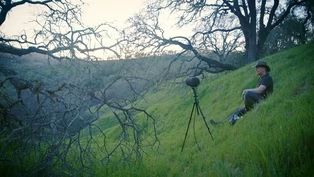
The Songs of Strangers Preview
Video has Closed Captions
Preview: Ep2 | 30s | Our culture was shaped by the sounds of nature. What could we learn if we listened again? (30s)
Providing Support for PBS.org
Learn Moreabout PBS online sponsorship
- Science and Nature

Explore scientific discoveries on television's most acclaimed science documentary series.

- Science and Nature

Capturing the splendor of the natural world, from the African plains to the Antarctic ice.










Support for PBS provided by: