
May 5, 2026 - PBS News Hour full episode
5/5/2026 | 57m 46sVideo has Closed Captions
May 5, 2026 - PBS News Hour full episode
May 5, 2026 - PBS News Hour full episode
Problems playing video? | Closed Captioning Feedback
Problems playing video? | Closed Captioning Feedback
Major corporate funding for the PBS News Hour is provided by BDO, BNSF, Consumer Cellular, American Cruise Lines, and Raymond James. Funding for the PBS NewsHour Weekend is provided by...
May 5, 2026 - PBS News Hour full episode
5/5/2026 | 57m 46sVideo has Closed Captions
May 5, 2026 - PBS News Hour full episode
Problems playing video? | Closed Captioning Feedback
How to Watch PBS News Hour
PBS News Hour is available to stream on pbs.org and the free PBS App, available on iPhone, Apple TV, Android TV, Android smartphones, Amazon Fire TV, Amazon Fire Tablet, Roku, Samsung Smart TV, LG TV, and Vizio.
Providing Support for PBS.org
Learn Moreabout PBS online sponsorshipAMNA NAWAZ: Good evening.
I'm Amna Nawaz.
Geoff Bennett is away.
On the "NewsHour" tonight: Tensions mount as the United States and Iran trade threats and compete for control of the Strait of Hormuz.
We explore how states are scrambling to redraw congressional maps ahead of November's midterm elections.
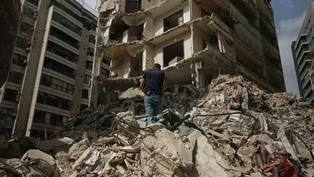
And nearly a month after Israeli strikes killed hundreds of people across Lebanon, victims' families still search the rubble for remains.
ALI ABOUD, Brother of Israeli Strike Victim (through translator): This is not a Hezbollah area.
This is a mixed area from different sects.
There were 22 bodies.
All those pulled from the rubble were women and children.
(BREAK) AMNA NAWAZ: Welcome to the "News Hour."
Top American officials said today the cease-fire with Iran had not ended, despite exchanges of fire in the Strait of Hormuz and Iranian attacks on U.S.
allies in the Gulf.
Both the secretaries of state and defense said the U.S.
was in a new phase of operations designed to ensure safe passage for commercial vessels stuck in the Persian Gulf.
But, so far, very few ships appear to want to run the Iranian gauntlet in the strait, and Iran remains defiant.
Nick Schifrin again begins our coverage.
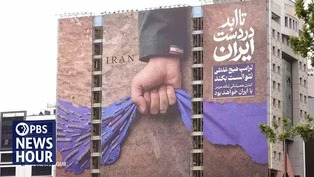
NICK SCHIFRIN: On the streets of Tehran today, even the statues are wrapped in nationalism.
Newspapers sneer at the U.S.'
new Project Freedom.
Signs celebrate regime continuity, and posters proclaim Iran's stranglehold on the Strait of Hormuz.
Iran's public rhetoric remains defiant.
Today, the Islamic Revolutionary Guard Corps warned that ships crossing the Strait of Hormuz without coordinating with Iran would be -- quote -- "categorically dealt with."
And on X, Iran's chief negotiator and Parliament speaker, Mohammad Ghalibaf, today accused the U.S.
of a violation of the cease-fire and warned: "We have not even begun yet."
And for the second day in a row, the United Arab Emirates said it was attacked by Iranian missiles and drones that yesterday hit Fujairah, the UAE's only major port that bypasses the Strait of Hormuz.
Yesterday, Iran also launched small boats like these and missiles at U.S.
ships, actions that today President Trump downplayed.
QUESTION: What do they need to do to violate the cease-fire?
DONALD TRUMP, President of the United States: Well, you'll find out, because I'll let you know.
They know what to do and they know what to do.
We -- and they know what not to do, more importantly, actually.
And they fired them in little boats with peashooters.
You know what a peashooter is?
A little boat with little you know what, because they don't have any boats anymore.
PETE HEGSETH, U.S.
Defense Secretary: The cease-fire is not over.
NICK SCHIFRIN: At the Pentagon, Secretary Hegseth also dismissed Iran's attacks on U.S.
forces yesterday as what he called frothiness.
PETE HEGSETH: We expected there would be some churn at the beginning, which happened.
NICK SCHIFRIN: But Iran's defiance extends to the negotiating table, where President Trump has acknowledged they refuse to accept us demands.
Until those talks are fruitful, President Trump today made clear he does not want to increase pressure on Iran by resuming the war.
DONALD TRUMP: We don't want to go and kill people.
We really don't.
I don't want to.
I don't want to.
It's too tough.
NICK SCHIFRIN: Instead, the U.S.
says it will maintain economic pressure, including new threats today on Chinese banks facilitating Iranian oil exports, and a diplomatic push at the U.N.
to condemn Iran's strait choke hold.
MARCO RUBIO, U.S.
Secretary of State: They're not going to change their position out of the kindness of their heart.
There has to be a pressure point on them that causes them to realize they cannot continue to close the straits, or they face crushing economic consequences, but also global diplomatic isolation, which they have proven in the past to be susceptible to.
NICK SCHIFRIN: But Iran's choke hold over the strait, through which 20 percent of the world's oil and natural gas traveled before the war, has not only affected American gas prices.
It has led to higher prices around the world, leading to food and humanitarian aid shortages.
MATTHEW HOLLINGWORTH, Assistant Executive Director, World Food Program: A lot of people can't afford to eat the basic commodities, the basic foods that they rely on.
NICK SCHIFRIN: Matthew Hollingworth is an assistant executive director at the World Food Program.
He says, since the war began and the Strait of Hormuz largely closed, food prices across Central and Eastern Africa have increased by as much as 50 percent at a time when WFP already faced aid cuts.
MATTHEW HOLLINGWORTH: We are in a situation today already because of this war that, 1.5 million people, we simply cannot afford to help anymore.
We know, in the next three months if the price of oil stays above $100 a barrel, that figure will jump to nine million more people that we will not be able to help.
NICK SCHIFRIN: WFP predicts the number of people who are food-insecure will increase by 45 million by the summer if the Strait of Hormuz that is so vital to all shipping isn't open.
Humanitarian organizations have tried to create work-arounds to avoid the strait, but it is not sustainable, says Hollingworth.
MATTHEW HOLLINGWORTH: We can go on different routes, but it does add, again, weeks and it adds serious cost.
The easiest, fastest way to do it is a resolution in the Middle East that will reopen these supply chains that the world desperately needs.
NICK SCHIFRIN: But, today, the strait remains largely closed and diplomacy at an impasse.
For the "PBS News Hour," I'm Nick Schifrin.
AMNA NAWAZ: In the day's other headlines: Senate Republicans are requesting a billion dollars to fund security improvements for President Trump's White House ballroom.
The money is attached to a broader measure they hope to pass this month aimed at funding ICE and Border Patrol.
Republicans have been pushing for the financing after a man was charged with trying to assassinate President Trump at a dinner late last month.
It's not clear exactly how the $1 billion would be used, but it is more than double the $400 million to build the ballroom, which the president said would be privately funded.
Ukrainian President Volodymyr Zelenskyy says his forces are observing a temporary truce tonight.
Earlier, Russia announced its own cease-fire for Friday and Saturday for Victory Day celebrations, marking the defeat of Nazi Germany in World War II.
But both sides are accusing the other of last-minute attacks.
In Ukraine, authorities say Russian strikes killed at least 22 people and wounded dozens more, as Moscow targets the country's power grid.
President Zelenskyy says the attacks prove what he calls Moscow's utter cynicism.
VOLODYMYR ZELENSKYY, Ukrainian President (through translator): A one-day cease-fire, but killing our people beforehand is, to put it mildly, simply not fair, dead, wounded, adults, children.
I'm sorry, but after all this to say, let's have a 24-hour cease-fire, that is not serious.
AMNA NAWAZ: Russia today released videos showing Ukrainian drones striking the city of Cheboksary east of Moscow.
Russia says three people were injured.
Ukraine says it was targeting military sites.
In Central China, authorities are investigating the cause of an explosion at a fireworks plant in Hunan Province that killed at least 26 people and injured dozens more.
Eyewitness video caught the sound of popping fireworks and smoke rising from the site yesterday.
China state broadcaster says investigators believe the blast started in a workshop where fireworks are made and packaged and that at least one company official has been detained.
Chinese President Xi Jinping called today for a prompt investigation and the punishment of those responsible.
The Equal Employment Opportunity Commission is suing The New York Times, alleging the newspaper discriminated against a white male employee when he was passed over for promotion last year.
The suit claims The Times violated federal laws that prohibit hiring or promotion decisions based on race or sex, saying -- quote - - "There is no diversity exception to this rule."
The unnamed employee filed a complaint with the EEOC last year after the job went to a person described as a nonwhite female.
The Times says it categorically rejects the allegations and is vowing to defend itself vigorously.
Meantime, the Trump administration is investigating whether Smith College violated anti-discrimination laws by allowing transgender students to enroll.
The inquiry by the Education Department's Civil Rights Office accuses the all-women's college of -- quote -- "admitting biological men."
It's an expansion of the Trump administration's push to limit the rights of transgender students, which until now has largely focused on sports and the use of women's bathrooms.
In response, the Massachusetts-based school says it's -- quote -- "fully committed to its institutional values, including compliance with civil rights laws."
In Georgia, Fulton County is seeking to block the Justice Department from acquiring the identities of every person who worked there during the 2020 election.
That is in response to a DOJ subpoena demanding the names and contact information of county employees and volunteer poll workers.
County officials call that order overbroad, saying it was meant -- quote -- "to target, harass, and punish the president's perceived political opponents."
It's the latest effort by the Trump administration to target the Democratic stronghold, which the president has falsely accused of widespread voter fraud in his 2020 election loss.
On Wall Street today, stocks rose as oil prices eased.
The Dow Jones industrial average gained more than 350 points.
The Nasdaq added around 250 points, or more than 1 percent.
The S&P 500 also closed firmly in positive territory.
And a pair of Broadway adaptations are leading the way among this year's Tony nominations.
"Schmigadoon!," a parody of Broadway musicals based on an Apple TV show, earned 12 nominations.
So too did "The Lost Boys" based on the 1987 teen vampire film.
Close behind are a pair of revivals, with "Ragtime" getting 11 nominations and Arthur Miller's "Death of a Salesman" earning nine.
June Squibb made history as the oldest ever Tony nominee at 96 for her performance in "Marjorie Prime."
And Danny Burstein is now the most-nominated male actor with nine career nods.
The Tonys will be handed out next month in New York.
Still to come on the "News Hour": a suspected outbreak of a rare and deadly virus kills three people aboard a cruise ship off the coast of West Africa; thousands of immigrant truck drivers lose their commercial licenses in the Trump administration's latest crackdown; author Douglas Stuart discusses his new novel about a fractured family in Scotland; and renowned musician Wynton Marsalis explains why he thinks jazz is the perfect metaphor for democracy.
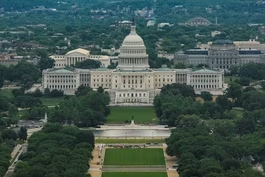
The Supreme Court ruling against drawing congressional maps to protect Black or other minority voters has sparked a new wave in the ongoing redistricting war.
Our congressional correspondent Lisa Desjardins joins me now.
She's back at the super screen for a look at where things stand.
So, Lisa, walk us through it.
How has the map changed in the last month?
LISA DESJARDINS: I mean, this is a historic moment in terms of how we draw our political lines.
It could easily become a blur.
So let's start, first of all, with where this is happening.
Let's go back, oh, even a whole month ago.
This is what the map looked like.
You see these four states that were redrawing toward Republicans' favor, two that had maps that were moving toward Democrats' favor.
You can notice these were all over the country.
Then something happened two weeks ago.
We saw action in Virginia.
Voters there passed a Democratic-leaning map, and, in Florida, the governor and legislature moved to put in place Republican-leaning maps.
That was two weeks ago.
Then we had last week's Supreme Court decision.
Look at how this changes things.
Now we have four more states interested in remapping.
And look at that shape.
It used to be this debate was spread out all over the country, but now we see a real focus on one region of the country, the South.
That is the where.
Now let's talk about what this means.
All of this remapping is really about just changing the odds.
It's not a guarantee of picking up seats, but let's talk about how those odds could play out.
First of all, these are the states that have new maps in place right now.
This is the maximum amount of seats Republicans can gain, the maximum for Democrats.
Essentially, it's a wash, especially because many of these Republican seats are more risky.
They're going to be harder for Republicans to pick up.
Now, let's add in if those four states in the conversation because of the Supreme Court do redistrict.
What happens?
Look at this.
Republicans increase their odds significantly.
What it means is they have more of a chance of gaining on net, Amna, because of redistricting.
AMNA NAWAZ: They used the word if a lot.
LISA DESJARDINS: That's right.
AMNA NAWAZ: It seems there's a lot of uncertainty still ahead even with just months to go before those midterm elections.
So what happens next?
LISA DESJARDINS: I think I can clear this up.
Think of the states in play right now in two ways, first, the states that are having court battles.
I want to focus on three, the state of Virginia.
We're waiting on the state Supreme Court to rule on the map there.
Florida.
Florida has a law banning partisan gerrymandering.
So, no surprise, there are lawsuits there.
We will watch courts.
Now, Louisiana, how about this?
Early primary voting is under way.
The governor has moved to suspend it for House races.
But that's why we have lawsuits in place in Louisiana.
We could get information on any of these as soon as this week.
Now let's talk about places you should be watching the legislatures, first, Tennessee and Alabama, both of these states holding special sessions right now to talk about redistricting.
Alabama, notable that they also need help from the Supreme Court, needs to lift a previous injunction.
But they are acting as if they will get that action from the Supreme Court.
Finally, Mississippi, how about this?
Their primary was in March for those House races.
Those candidates are running their races for the fall.
But there is a special session there coming up in May.
AMNA NAWAZ: Lisa, what does ultimately all of this mean when it comes to minority representation, which the Voting Rights Act was meant to protect?
LISA DESJARDINS: That's right.
Now, this is a debate over -- of course.
But when you look at it in net, if all of this were to take place, it is highly likely that we'd see fewer Black and brown members of Congress next year.
One of those members of Congress whose district is likely targeted is in Alabama.
That's Terri Sewell.
REP.
TERRI SEWELL (D-AL): It will not only suppress minority votes in the halls of Congress, but it will erode minority representation in statehouses, city councils, and even school boards across this nation.
LISA DESJARDINS: Now, one way to look at this is about the current composition of these delegations.
Red - - these are the red Republican members of Congress from each state, blue, Democrats.
What does that matter?
Many of these blue districts are majority-minority districts drawn in part because of the Voting Rights Act.
Many of these are Black members of Congress.
Keep your eye on the center of this screen and you can see what happens if all of the redistricting that Republicans want goes into place.
Those blue districts disappear.
Now, Republicans say they think this is more fair.
They want to take race out of it, and they say they would like to recruit.
They're hopeful that perhaps they can get some Black and brown candidates.
But if they don't, those who support the Voting Rights Act say, this would be a historic shift.
We would see far fewer Black and brown members of Congress.
Perhaps the red and blue balance might not change, but the balance in terms of who is in Congress by race could.
AMNA NAWAZ: We know you will continue to follow this story in the weeks and months ahead.
Lisa Desjardins, thank you very much.
LISA DESJARDINS: You're welcome.
AMNA NAWAZ: Three people are dead and nearly 150 quarantined on a cruise ship off the coast of West Africa.
The World Health Organization is investigating an outbreak of the rare, but deadly hantavirus on board.
William Brangham has more.
WILLIAM BRANGHAM: Amna, there is no cure or FDA-approved vaccine for hantavirus, which is normally spread by contact with infected rodents.
But the WHO said today they believe there's evidence of a rare instance of human-to-human transmission on that ship.
The agency has identified two confirmed and five suspected cases, including the three deaths.
One man is now in critical condition in an ICU in South Africa.
The WHO says the risk to the public remains low.
But for more on this outbreak, we are joined again by Dr.
Celine Gounder.
She is editor at large for public health at KFF Health News and an infectious disease specialist and epidemiologist.
Dr.
Gounder, nice to have you back on the program.
Before we get to this particular outbreak, just tell us a little bit about what is hantavirus and how do humans normally get infected by it?
DR.
CELINE GOUNDER, KFF Health News: William, hantavirus is in fact a family of viruses that are carried by rodents.
So people typically get infected by breathing in dust that has been contaminated with mouse or rat droppings, urine or saliva.
And most infections are happening when somebody disturbs a rodent contaminated-space.
So it might be cleaning out a shed or sweeping in the basement, opening a building that's been closed for a while.
In the U.S., the severe form is called hantavirus cardiopulmonary syndrome, so cardio, the heart, pulmonary the lungs.
It starts with fever, headache and muscle aches, but then can rapidly progress to severe breathing problems and shock.
And then, depending on exactly which hantavirus between 12 and 45 percent of people who develop that severe form go on to die.
But I think it's really important to emphasize that this is exceedingly rare.
In the United States, we have had less than 900 cases over the past 30 years.
And, globally, there are an estimated 200,000 to 300,000 infections a year, most of which are milder forms seen in Europe and Asia.
WILLIAM BRANGHAM: So what do we know about this outbreak on the ship?
And how concerning should it be that the WHO seems to believe that there is human-to-human transmission of the virus?
DR.
CELINE GOUNDER: So this is a ship that departed from Ushuaia in Argentina on April 1 and sailed through Antarctica and up the coast of Africa.
As of today, seven people have been affected, three passengers have died, and two cases have been confirmed to be hantavirus by lab tests, including one of the passengers who has died.
As you mentioned earlier, there is one person who's in intensive care in South Africa.
They are in critical, but stable condition.
And there have been at least an additional person who is reporting a mild fever now.
The WHO and South African authorities and others have been working on investigating these cases, taking samples from patients.
But, for now, the passengers remain aboard the ship, the remaining passengers, to be quarantined until the situation can be thoroughly investigated.
WILLIAM BRANGHAM: Let's say that the WHO does confirm a human-to-human transmission.
Does that -- I know that can be rare.
It does happen with hantavirus.
But would that potentially indicate that this virus is shifting or mutating in some way?
DR.
CELINE GOUNDER: So, we know that there is one form of hantavirus, Andes virus, which circulates in Argentina and Chile that has been documented to spread person to person.
No other hantavirus does this, but this one does.
We have evidence going back to the late '90s showing evidence of person-to-person transmission.
So it's quite rare, but, with this particular form of hantavirus, it is possible.
But I do think it's important that people understand that this still requires very close, prolonged contact.
It's very different still from viruses that can become pandemics, like COVID or flu, which can be transmitted much more easily through the airborne respiratory route.
WILLIAM BRANGHAM: All right, that is Dr.
Celine Gounder at KFF News.
Thank you so much, as always, for being here.
DR.
CELINE GOUNDER: My pleasure.
AMNA NAWAZ: Tomorrow marks four weeks since the day now known as Black Wednesday in Lebanon.
On April 8 the Israeli military, claiming to target Hezbollah militants, unleashed an unprecedented aerial campaign, killing more than 350 people in a matter of minutes.
Special correspondent Simona Foltyn reports.
SIMONA FOLTYN: For days after Israel struck this Beirut neighborhood on April 8, Ali Aboud kept coming back to look for his sister, Zahraa.
With the help of rescue workers he's making a final attempt to find her underneath the rubble of what used to be his aunt's home.
ALI ABOUD, Brother of Israeli Strike Victim (through translator): They will start by moving the rubble over there.
They will see if there's anything, if there's a smell, and they will leave the removal of the rubble until the very end.
SIMONA FOLTYN: Zahraa was 26 years old, the youngest of four siblings.
She held a bachelor's in biochemistry and was pursuing her master's, a young promising life wiped out in the blink of an eye in what the Israeli military called Operation Eternal Darkness.
It was April 8, the first day of the cease-fire between the U.S., Israel and Iran, just when many Lebanese thought the worst was over.
Israel dropped more than 100 bombs on Lebanon in the span of just 10 minutes.
The unprecedented attack hit densely populated neighborhoods during Beirut's afternoon rush hour and without warning.
Ein el Mreisseh on Beirut's waterfront Corniche, once deemed safe, was attacked for the first time that day.
ALI ABOUD (through translator): My dad called me that there was a strike on your aunt's house, and your sisters can't be found.
When we first started the search we pulled out 22 bodies.
Every time a new body was found, I prayed it wasn't Zahraa, because I still hoped that she was alive in one of the hospitals.
SIMONA FOLTYN: But with every passing day, the hope that Zahraa would be found alive has faded away.
All they can hope for now is to find her body.
They go up to the first-floor apartment to understand where Zahraa might have been when Israel struck.
ALI ABOUD (through translator): It was lunchtime.
My aunt and the housekeeper were preparing food in the kitchen and they retrieved them from the kitchen.
Zahraa was in her room.
SIMONA FOLTYN: That room is now a gaping hole ripped away by the Israeli missile as it tore through the six-story apartment building; 18 families lived here, including Ali's aunt.
Zahraa on the right and her sister Malak on the left had come from Southern Lebanon to stay with them when the war erupted in early March.
ALI ABOUD (through translator): The girls were very scared.
They were forced to go to their aunt's house here in Ein el Mreisseh, an area that was considered safe.
SIMONA FOLTYN: And so who was inside the apartment when the strike happened?
ALI ABOUD (through translator): They were all there, my two aunts, my aunt's husband my two sisters and the Sri Lankan maid.
SIMONA FOLTYN: Of the six people in the apartment, Malak was the only one to be pulled from the rubble alive.
Ali's two aunts, his uncle and Zahraa were killed.
The Israeli military said it was targeting Hezbollah.
ALI ABOUD (through translator): It's all lies.
This is not a Hezbollah area.
This is a mixed area from different sects.
And this is one of the oldest buildings.
There were 22 bodies.
All those pulled from the rubble were women and children and my aunt's husband, who was 82 years old.
He couldn't even walk properly.
SIMONA FOLTYN: They were among at least 357 people killed on April 8.
It was the deadliest day of the war and became known as Black Wednesday.
Nine days later, when the cease-fire finally went into force in Lebanon, funerals were held across the country.
In Beirut's southern suburbs, people gathered to remember Ola Al-Attar, a 32-year-old mother of two.
Relatives and friends try to counsel Ola's mother as she cries out for her daughter.
Her two sisters are still in disbelief.
ROULA AL-ATTAR, Sister of Israeli Strike Victim (through translator): She didn't come home.
I was asking, where was the strike?
Where was the strike?
My mom said it was the place where Ola worked.
She said, your sister is gone.
What do you mean my sister is gone?
Where was she?
She went to work.
She works at a dentist.
SIMONA FOLTYN: Ola wasn't the first in her family not to come home.
Her husband, Hamad Al-Attar, worked at the Beirut port and was killed in a devastating explosion in 2020.
That explosion, caused by the improper storage of ammonium nitrate fertilizer in the port silos, killed 218 people.
Ola joined other victims' families in a push for accountability, but death came faster than justice.
She was killed six years after her husband, leaving behind two daughters, Zahraa, aged 12, and Fatima, 7.
Their paternal grandmother and their aunt have stepped in to try to replace the irreplaceable.
MONA AL-SEIF, Grandmother of Zahraa and Fatima al-Attar (through translator): Their mother was everything for the girls.
Can someone replace a mother?
Ola carried a heavy burden.
Children are a responsibility.
You have to bring them to schools, to doctors.
It was difficult to lose Hamad, but Ola closed the gap.
At my age, I can't do what Ola was doing.
SIMONA FOLTYN: The loss of both parents has forced Zahraa into a job no 12-year-old should have.
ZAHRAA AL-ATTAR, Child Orphaned by Israeli Strike (through translator): My sister and I, we have become orphans.
But, of course, I will go support my sister.
I will go to school and I will study.
I will raise my head so that my mother and my father can be proud of me.
SIMONA FOLTYN: Zahraa is still in therapy to overcome her father's death, and must now reckon with having found her mother's body.
On top of that, there is the persistent fear of more Israeli strikes.
ZAHRAA AL-ATTAR (through translator): If I hear a civilian playing, I'm scared.
I feel that a rocket will fall on me.
SIMONA FOLTYN: Fatima no longer likes being at home.
She spends most of her time downstairs with her aunt Nancy.
NANCY FNEISH, Aunt of Zahraa and Fatima al-Attar (through translator): She holds on to me at night, the way she used to sleep with her mother, hugging her because she was afraid to lose her.
SIMONA FOLTYN: Zahraa visits the place where her mother was killed every day to look for her mobile phone, she says, or perhaps for answers that might never come.
The Israeli military claimed to have killed 250 Hezbollah operatives on April 8.
For the IDF's claims to be true, all the male victims would have to be fighters.
But, in reality, many were ordinary civilians like Jamal Jarab.
He was 26, a refugee from Syria, and an aspiring chef at a well-known Asian restaurant in Beirut.
Wael Lazkani is the restaurant's owner.
WAEL LAZKANI, Owner, Jai Restaurant: He was very sweet, very much the strong and silent type.
Like, you couldn't get a word out of him even when I wanted to, like, just very kind of holding it together, but extremely kind.
SIMONA FOLTYN: Jamal had recently married and had a 4-month-old daughter.
He was working his way up and had just been promoted to prep cook.
WAEL LAZKANI: It's kind of tough to accept that a child, like, really just a kid, who came here to have a better life, escape war and build a safe and happy life for himself, ends up being massacred in broad daylight.
You don't hit 20 sites at 2:30 when schools get out, when everybody's out for lunch targeting Hezbollah.
You actually -- you're - - here, you're aiming for civilians.
SIMONA FOLTYN: Jamal's absence is dearly felt in this tight-knit community.
Yasser Al-Omar is the head chef and, just like Jamal, from Aleppo, Syria.
YASSER AL-OMAR, Head Chef, Jai Restaurant (through translator): He was lighthearted.
He never annoyed anyone.
He worked with sincerity.
We feel a bit depressed.
When we come here, we still imagine him here.
SIMONA FOLTYN: Eleven days after Zahraa was killed, some of her remains were finally found and identified through DNA analysis.
We joined the family as they visited the cemetery in her village, her final resting place.
ALI ABOUD (through translator): We got upset and relieved at the same time.
We got assurances that it was indeed Zahraa, that she was martyred.
We were relieved that we found something of her to bury.
Thank God we could honor her.
SIMONA FOLTYN: Burying the dead is the only form of closure they can get.
There is little hope for accountability.
ALI ABOUD (through translator): If there was justice through international law, we wouldn't have gotten to this point.
I lost my sister.
The only justice lies with God.
Other than that, there's no justice.
SIMONA FOLTYN: But these families will never forget.
Black Wednesday will be remembered here as one of the darkest days in a history littered with massacres, the trauma forever etched into collective memory.
For the "PBS News Hour," I'm Simona Foltyn in Lebanon.
AMNA NAWAZ: In March, some 200,000 immigrants began losing their commercial driver's licenses, which are required to operate large vehicles like semitrucks, buses and tractor trailers.
It's part of a series of moves by the Trump administration to limit who can drive those vehicles after some high-profile crashes involving foreign-born drivers.
Lisa Desjardins is back now with the story.
MYNOR SOLARES, Former Truck Driver: This is the backbone of America.
Everybody needs their goods.
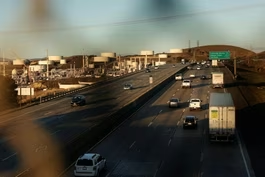
LISA DESJARDINS: For over a decade come rain or shine, Mynor Solares of Portland, Oregon, drove a semitruck across the Western U.S.
But, suddenly, he has to end that career and with it the main source of income for his family of five.
MYNOR SOLARES: When I first heard of it, my heart started racing.
I feared for the worst as soon as I heard it, and I was like, hey, I'm going to lose my license.
I'm not going to be able to renew.
LISA DESJARDINS: In March, a Trump administration rule took effect barring some groups of immigrants with temporary status, including DACA recipients like Solares, from getting or renewing their commercial driver's licenses.
Citing a handful of fatal crashes involving immigrant truckers, the rule also applies to refugees and asylum seekers.
Solares was brought to the U.S.
illegally from Guatemala when he was 2 years old.
At 14, he enrolled in DACA, which allowed him to legally work in the U.S., ultimately owning his own trucks.
MYNOR SOLARES: I love the job.
LISA DESJARDINS: He's driven for 12 years, but, late last month, his license expired.
And due to the new rule, he can't renew it.
MYNOR SOLARES: They use the word safety.
You're using it as a disguise.
I believe your intentions are different, and safety could be one of them, but you're using that more of a playing card more than reality that what you're really trying to do.
I think they're trying to push their immigration agenda into the trucking industry.
LISA DESJARDINS: In the final rule, the Trump administration cited 17 fatal trucking accidents in 2025 it says were likely caused by noncitizen truck drivers.
But that is less than 1 percent of the fatal crashes caused by truckers each year.
That one group of cases, though, have become major headlines.
WOMAN: Three people were killed when a semitruck driven by an illegal immigrant plowed into traffic.
MAN: We do have new details after an undocumented migrant truck driver was charged with causing a crash.
MAN: An illegal immigrant truck driver suspected in a crash.
SEAN DUFFY, U.S.
Transportation Secretary: We have people on the roads that aren't safe, that aren't qualified that should never have the driver's license.
LISA DESJARDINS: But the drivers losing their licenses have met current requirements for qualification.
This is part of a broader effort to limit who can drive trucks in the U.S.
Trump ordered more penalties for truck drivers who aren't English-proficient even though that is already a requirement.
And during the State of the Union Trump urged, Congress to pass a road safety law, going further, immediately revoking all trucking licenses from most drivers with temporary status, a law named after a little girl.
DONALD TRUMP, President of the United States: Dalilah Coleman was only 5 years old in June 2024 when an 18-wheel tractor trailer plowed into her stopped car traveling at 60 miles an hour or more.
The driver was an illegal alien.
LISA DESJARDINS: In the balcony, Dalilah smiled in the arms of her dad.
She's relearning how to walk.
And after seeing his daughter nearly die from the crash, Marcus Coleman is on a mission.
MARCUS COLEMAN, Father of Dalilah Coleman: It's taken a toll on us in every which way possible.
LISA DESJARDINS: Coleman is pushing for a number of changes on the highways, including the blocking of some immigrants from driving trucks.
There is no evidence that immigration status directly connects to driver safety, but Coleman says the statistics don't show the impact on people like him and Dalilah.
MARCUS COLEMAN: I think 17 accidents, even if it's out of 100,000, is 17 too many.
I see the significance in the number.
Every single person who's been impacted by this, we see the significance.
We are that small number.
And there's starting to become enough of us.
WENDY LIU, Public Citizen Litigation Group: Every crash resulting in fatality or serious injury is a tragedy.
LISA DESJARDINS: Wendy Liu is an attorney at Public Citizen Litigation Group and is leading a lawsuit against the Department of Transportation rule, saying it is harmful, not helpful.
WENDY LIU: There is no data to support the notion that immigrant status has anything to do with whether somebody is a safer driver.
Requirements to get these licenses are extensive.
If the issue is that states are improperly issuing licenses to people who don't meet those requirements, then the right response is to tighten the administrative steps to make sure that licenses are not going to people who don't meet the requirements.
It's not to impose this blanket wholesale exclusion on documented immigrants.
LISA DESJARDINS: In other words, the White House should look at issues in the overall system.
Even supporters of this rule see that, like Lewie Pugh with the Owner-Operator Independent Drivers Association, a group of truck drivers and small trucking companies.
He is concerned about recent immigrants... LEWIE PUGH, Owner-Operator Independent Drivers Association: We don't have any history on what these folks' driving ability is.
LISA DESJARDINS: ... and likes this new rule for that reason.
But he says this does not address a far larger problem,trucker training and so-called license mills that approve new drivers easily.
LEWIE PUGH: In the state of Missouri, it takes over 1,600 hours of training to be a barber, but yet, to drive a truck, I mean, it's a matter of you got to pass a test and drive around some cones and you're a truck driver.
I don't know anybody who died from a bad haircut, but lots of people can die from an ill-trained, bad truck driver.
So that's why we need to make sure these people are trained correctly, understand the rules of the road, and that's what we need to be working toward.
NARRATOR: Improving safety on our nation's roadways.
LISA DESJARDINS: There are clear federal standards for training commercial drivers, but, late last year, the government found more than 40 percent of all trucking schools may not be following the federal regulations.
BILL JONES, Waste Pro: This rule that lumps people into buckets based on where they're born or what their immigration status is isn't really getting to the root of the cause.
LISA DESJARDINS: Bill Jones is a divisional vice president at the waste and recycling collection company Waste Pro, and this rule threatens the work force his company has spent years and dollars to train right.
BILL JONES: I think long term the biggest concern is that this rule reduces the available pool of talented and safe drivers in an already difficult work environment.
And, allegedly, it is focused on safety, but I've got people that have driven free for 15, 20 years, been safe, won all sorts of safety awards with the company, and suddenly they can't drive.
So I'm not sure it's really safety.
LISA DESJARDINS: In California, Dalilah Coleman faces lifelong therapy.
Marcus Coleman understands the politics here, and banning DACA recipients gives him pause, but he won't risk political momentum by separating them out.
MARCUS COLEMAN: I feel bad for their situation.
I honestly do.
I don't want Dalilah's Law to go against DACA.
At the same time, I can't include DACA in Dalilah's Law.
It would misrepresent what it is that it's going for.
LISA DESJARDINS: Back in Portland, Oregon, all this has left DACA recipient Solares in a mechanic's job that pays less than a third of what he made driving trucks, not enough to cover the bills.
MYNOR SOLARES: I think just putting everybody, generalizing everybody that's not a United States citizen isn't the right move.
I'm American, you could say, at heart and in my mind.
That is all I have known in the United States.
Paperwork, immigration status is the only thing that's making me look different than everybody else here.
LISA DESJARDINS: And just that status, not his driving record, means he is one longtime safe driver being forced off the road.
For the "PBS News Hour," I'm Lisa Desjardins.
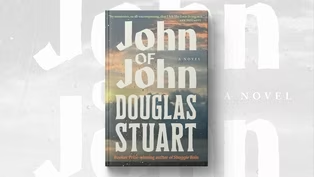
AMNA NAWAZ: In 2020, dogs won the Booker Prize for his debut novel, "Shuggie Bain," said in 1980s Glasgow about a boy caring for his mother struggling with alcoholism.
His latest novel, "John of John," out today, follows Cal, a young man returning to his hometown on a rural Scottish island and grappling with his identity, his religion, and his father, John.
Geoff Bennett spoke to Stuart for the latest episode of our podcast "Settle In."
Here's a clip of their conversation.
GEOFF BENNETT: Where did this story come from.
And did you know where John and Cal were headed when you started?
DOUGLAS STUART, Author, "John of John": Yes, I actually began this novel in 2019, when I was waiting for my debut novel, "Shuggie Bain," to publish.
I was filled with anxiety, and I'd sort of taken my fashion career and put it on hiatus, and I was wondering if that was the right thing to do to risk it on my dreams of becoming a writer.
And so I was looking at my husband one day, and I said: "I have an idea for a new novel I want to write, but I have to go to the Outer Hebrides."
And as a kid growing up in the inner city of Scotland, I'd never been to the islands.
You know, it's a -- the Outer Hebrides are an archipelago of islands that sit off the northwest coast of Scotland.
And they're absolutely stunning, but they're quite difficult to get to.
And so I think my husband was sick of dealing with my anxiety and he said: "Twelve weeks away from me sounds like a great idea."
And so he totally cosigned me going to the islands.
But I showed up on the islands in 2019 knowing only two people.
And I was there, first of all, for 12 weeks.
And I just sort of traveled up the islands and got a sense of my own country, a sense of the people.
And I found that everybody was incredibly generous with their time.
They were curious about what I was doing, what I was interested in.
And I fell in love with the place.
I sort of journeyed up from -- there's a very small island at the bottom called Vatersay, and I went up about four to five islands until I got to the isle of Harris, which is almost near the very top.
And when I got there, I realized that there was a convergence of fascinating things.
First, it's the last stronghold of Scottish Gaelic, the language.
It is the sort of home of a very conservative Calvinism.
There is beautiful Harris tweed weaving and then there's a crofting way of life that's sort of dying, subsistence farming, that is not so common these days.
And when I was on the island, I just thought, this is -- there is a story here.
It's this wonderful, almost lunar landscape, very rocky, quite barren.
The elements are very wild.
And I just thought, oh, there's a story here.
But I thought the story was about a young man who had gone to art school.
And in that wonderful moment we all have when we first leave home and we think we can expand and become who we are going to be, my protagonist is actually called by his father and says, you have to come home.
Your grandmother's sick.
And so he does the dutiful thing.
He loves his grandmother very much.
And so he sort of puts his own life away and he comes home to the island.
And as soon as he gets home, he realizes his grandmother's in fine health.
And so something else is actually afoot.
And I thought that was going to be the novel, but on my trip when I was on the islands, I was sort of sitting at a lot of kitchen tables, just meeting islanders.
And I was about five weeks into my trip, and I had heard frequently, when I would go from settlement to settlement, that there would maybe be an unmarried man or some bachelors in -- or spinsters in each settlement.
And I often ask, why didn't they marry?
Why weren't they interested in marrying?
And the answer would be often, well, they missed their moment for love.
The person would say, there's a very short window and you don't meet so many people when you live so far away, and they just missed their moment to meet that special person.
And I had been listening to that for some weeks.
And I said just very casually, well, of course, some of them might be gay, and that makes it harder.
And the woman I said it said: "Oh, no, no, no, that's not possible."
And she was neither cruel nor homophobic, but, for her, it was just not a thing she could imagine.
And I thought, oh, there's the novel.
It's not really about the son returning home.
It's about the home he returns to and about the father and the grandmother who he's left behind who couldn't quite become who they were meant to be either.
GEOFF BENNETT: The novel gives us two points of view.
You have got John's.
You have got Cal's.
We understand each man completely, even when they're hurting each other.
DOUGLAS STUART: Right.
GEOFF BENNETT: Reading it, I thought to myself, this -- I mean, you talk about the challenge.
I mean, that is a Herculean task to structure a book that way.
Why that approach?
DOUGLAS STUART: That's a great question.
I think, emotionally, first of all, I didn't know my own father.
And I'd written two novels about a son's relationship with his mother and how that can sort of change a life.
And I went into this thinking I wanted to explore what a love between a father and a son was, almost in a completely imagined way, because I had no reference in my own life.
But I had been raised around a lot of men who would put a lot of energy into avoiding the emotional truth.
They would never speak about how they felt or what their own feelings were in life.
They did -- the men that I was raised around did really difficult, dangerous jobs.
And I think if they started to talk about their feelings, then everything would unravel, because the very first thing you would say is, I don't want to go into a coal mine.
I'm scared.
I'm underpaid.
I feel undervalued.
And so, instead, in order to protect themselves and to protect the families, they would say nothing about their feelings.
And so the book becomes about that in a way.
They are sheep farmers.
And John doesn't express how he feels very much, but they love each other, father and son.
And a lot of their frustration is about the fact that they cannot communicate.
They can't actually say who they are and what they want and how the other lets them down.
Cal feels very much like his father wants to control him.
And when masculinity is expressed very narrowly, something that fathers do is, they try to make sure their sons come out in that image and there's sort of -- it's almost as a protective thing, that your masculinity has to be tough and macho and quite stoic.
On the other hand John, the father, feels like Cal doesn't respect everything he has sacrificed, everything he has built, that Cal looks at their home and their farm and their croft almost like it's worthless and it's a bore and, who would want to do this?
And so, in that sort of misunderstanding, the men are trying to love each other, but the thing is, it was almost a sort of exercise in how -- as a writer's exercise, in, how claustrophobic could you make this relationship?
How could you take these two characters that almost know everything about each other, but then won't say the things that are sort of closest to their hearts?
And how far could I push men together in that way?
They work and they worship and they eat together.
They're together all the time.
And yet there's so much they're withholding.
AMNA NAWAZ: And you can watch that full episode and all of our PBS News podcasts on YouTube or wherever you get your podcasts.
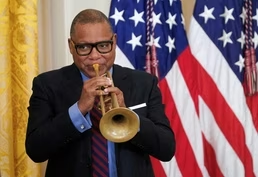
He's been called the Pied Piper of Jazz and Doctor of Swing, but renowned Trumper and composer Wynton Marsalis has now launched a new project, a kind of call and response for these times.
Senior arts correspondent Jeffrey Brown met Marsalis at the Jazz at Lincoln Center for our series Art in Action, exploring the intersection of art and democracy, part of our Canvas coverage.
JEFFREY BROWN: The music is vibrant and alive, but, says Wynton Marsalis, our democracy is threatened, with warning signs everywhere.
WYNTON MARSALIS, Musician: I'm seeing what we all are seeing.
We're lost.
We're blindly flailing about the world.
JEFFREY BROWN: And while many responses are possible, his, as always, is jazz, an art form of individual statements or improvisation and collective swinging together, music, he believes, to heal divisions.
WYNTON MARSALIS: Our music takes us away from that into the feeling of community, which is shared responsibility, shared rights and the creation of space for others to be creative and to be a part of the process.
And it's just an assertion of who we are and a reassertion of the importance of freedom and of civic engagement by artists.
JEFFREY BROWN: Marsalis has been a leading cultural figure for decades, founder of Jazz at Lincoln Center in New York in 1987, its artistic director ever since.
He was born into a musical New Orleans family, from early on playing with older brother Branford, learning from their father, Ellis, a pianist and educator who died in 2020.
WYNTON MARSALIS: I want as much as possible to try to communicate to you all.
JEFFREY BROWN: A key mission, preserving and passing on that tradition, as we saw in 2011 as he led a festival for high school musicians around the country called Essentially Ellington that continues to this day.
Marsalis was born and raised in the cauldron of the 1960s and, he says, now sees a nation in peril once again.
WYNTON MARSALIS: We have very bad leadership, not just the president, all over, very bad leadership.
Terrible leadership is easily corrupted.
And we need to assert -- those of us in the nation who believe in a plural America need to strongly assert it.
We need to be figuring out a creative vision that brings us together.
JEFFREY BROWN: His answer?
JazzCall for Freedom, a new multipart project that includes a video series intended as a kind of civic engagement dialogue, starting with professional musicians choosing and recording a brief clip of music from a song from the past that they think speaks to our moment.
ALEXA TARANTINO, Saxophonist, Jazz at Lincoln Center: It's really stripped down and right to the core, and that's exactly what this initiative is.
It's getting to the heart of the matter.
JEFFREY BROWN: Alexa Tarantino, a saxophonist, composer and band leader in her own right, is a member of the Jazz at Lincoln Center Orchestra.
She worked with Marsalis to choose leading contemporary musicians to participate.
ALEXA TARANTINO: The main element of jazz and performance is call and response and communication.
And so the fact that we are able to start something like this that puts out our own form of creative expression and encourages others to respond with theirs, it's that musical element personified, but with this political charge.
JEFFREY BROWN: Among the videos recorded so far, Cecile McLorin Salvant singing Stevie Wonder's "Visions," the group New Jazz Underground with Sonny Rollins' "Freedom Suite," students from Jazz at Lincoln Center's Jazz Academy performing "America the Beautiful," and one by Chris Lewis, another composer and band leader, as well as sax player with the orchestra.
His pick, a piece by jazz great pianist McCoy Tyner, who died in 2020, titled "Contemplation."
CHRIS LEWIS, Saxophonist, Jazz at Lincoln Center: He recorded it in the 1960s, which at a time -- tumultuous time in American history, right, civil rights movement.
And so to him that was a time of contemplation.
JEFFREY BROWN: What is a piece like that say now?
CHRIS LEWIS: I think it's a time for us to be contemplative of what's going on both internally and externally.
And so it's important for us to engage with our community and to understand that your value system is not necessarily the only value system.
And jazz teaches us that.
It teaches you that I believe this thing.
But just because I believe this does not mean that your belief system is invalid.
We both can believe different things and respect that and also create music together.
JEFFREY BROWN: In turn, the responses are now coming in from music-loving and playing citizens from around the country recording songs meaningful to them.
Marsalis is also looking to history with other parts of the JazzCall for Freedom with audio recordings including "Let Freedom Swing," a 2004 live performance that featured new jazz compositions with texts by leaders of the past such as Nelson Mandela, read by Morgan Freeman... MORGAN FREEMAN, Actor: I cherish my own freedom dearly, but I care even more for your freedom.
JEFFREY BROWN: And Vaclav Havel read by Alfre Woodard.
ALFRE WOODARD, Actress: That I stand behind what I do.
JEFFREY BROWN: What does it all add up to?
If I'm looking at like a minute video of a piece of music, "Visions" by Stevie Wonder or a piece by Sonny Rollins, McCoy Tyner, Duke Ellington, what does that actually do?
I mean, does that change anything?
WYNTON MARSALIS: Music is the art of the invisible.
So yes, a song -- you think of the freedom songs of the '60s.
You think of the songs that we rely on today that have a consciousness.
And you think of all the classic hymns and great songs that we have -- people have sung around the world, not just our songs.
Music is the art of the invisible.
So it touches things deep inside of us.
JEFFREY BROWN: As for Marsalis himself, he recently announced he will step down as head of Jazz at Lincoln Center next year, a huge shift for an institution that's aimed at giving jazz a place in the larger culture and for him.
WYNTON MARSALIS: It's just that time.
There's no bad reason.
We have a lot of great, fantastic talented younger musicians.
We have dedicated older members.
It's time for me to be one of those members.
It's time for me... (LAUGHTER) JEFFREY BROWN: You're feeling that?
WYNTON MARSALIS: Oh, man, it's that time.
But it's just I have been in the public space a long time, since I was 18 or 19.
JEFFREY BROWN: Yes.
Yes.
You're not retiring?
WYNTON MARSALIS: No, the musicians don't -- we don't retire.
We always -- and I will always be a part of the institution as needed, and, of course, for the art form.
I mean, it defines my life.
My father was a jazz musician.
I grew up in the culture of music.
And there's no greater cause I could put any time to the service of than this fantastic music that's had so many great musicians.
JEFFREY BROWN: An art form he insists as urgent and necessary as ever.
For the "PBS News Hour," I'm Jeffrey Brown in New York.
AMNA NAWAZ: And that is the "News Hour" for tonight.
I'm Amna Nawaz.
On behalf of the entire "News Hour" team, thank you for joining us.
 New
NewFamilies in Lebanon search for victims of Israeli strikes
Video has Closed Captions
Families in Lebanon still search rubble for loved ones killed in a day of Israeli strikes (8m 44s)
 New
NewIran defiant as U.S. pushes to reopen Strait of Hormuz
Video has Closed Captions
Iran remains defiant as U.S. launches new effort to reopen Strait of Hormuz (4m 50s)
 New
NewNews Wrap: Senate GOP requests $1 billion for Trump ballroom
Video has Closed Captions
News Wrap: Senate GOP requests $1 billion in funding for Trump’s ballroom (5m 51s)
 New
NewStates scramble to redraw congressional maps before midterms
Video has Closed Captions
New wave of Southern states scramble to redraw congressional maps ahead of midterms (5m 2s)
 New
NewThousands of immigrant truckers lose CDLs in Trump crackdown
Video has Closed Captions
Thousands of immigrant truckers lose commercial licenses in Trump administration crackdown (8m 8s)
 New
NewWhat inspired Douglas Stuart’s new novel ‘John of John’
Video has Closed Captions
How author Douglas Stuart’s journey to a remote Scottish island inspired ‘John of John’ (6m 46s)
 New
NewWhat to know about human-to-human hantavirus transmission
Video has Closed Captions
Can hantavirus spread between humans? What to know as WHO investigates ship outbreak (4m 54s)
 New
NewWynton Marsalis on why jazz is democracy’s perfect metaphor
Video has Closed Captions
Why Wynton Marsalis thinks jazz is the perfect metaphor for democracy (7m 57s)
Providing Support for PBS.org
Learn Moreabout PBS online sponsorship
- News and Public Affairs

Today's top journalists discuss Washington's current political events and public affairs.

- News and Public Affairs

FRONTLINE is investigative journalism that questions, explains and changes our world.












Support for PBS provided by:
Major corporate funding for the PBS News Hour is provided by BDO, BNSF, Consumer Cellular, American Cruise Lines, and Raymond James. Funding for the PBS NewsHour Weekend is provided by...