
Dermatologist explains benefits of new sunscreen ingredient
Clip: 6/15/2026 | 5m 45sVideo has Closed Captions
Dermatologist explains benefits of newly approved sunscreen ingredient
For the first time in more than 25 years, the FDA has approved a new active ingredient for over-the-counter sunscreens. It clears the way for manufacturers to begin using bemotrizinol, or BEMT, an ingredient that's been used in Europe and Asia since the 1990s. Amna Nawaz discussed why this change took so long and what people should know about it with dermatologist Dr. Rachel Nazarian.
Problems playing video? | Closed Captioning Feedback
Problems playing video? | Closed Captioning Feedback
Major corporate funding for the PBS News Hour is provided by BDO, BNSF, Consumer Cellular, American Cruise Lines, and Raymond James. Funding for the PBS NewsHour Weekend is provided by...
Dermatologist explains benefits of new sunscreen ingredient
Clip: 6/15/2026 | 5m 45sVideo has Closed Captions
For the first time in more than 25 years, the FDA has approved a new active ingredient for over-the-counter sunscreens. It clears the way for manufacturers to begin using bemotrizinol, or BEMT, an ingredient that's been used in Europe and Asia since the 1990s. Amna Nawaz discussed why this change took so long and what people should know about it with dermatologist Dr. Rachel Nazarian.
Problems playing video? | Closed Captioning Feedback
Where to Watch PBS News Hour
PBS News Hour is available to stream on pbs.org and the PBS app.
Providing Support for PBS.org
Learn Moreabout PBS online sponsorshipWILLIAM BRANGHAM: For the first time in more than 25 years, the Food and Drug Administration has approved a new active ingredient for over-the-counter sunscreens.
In a recent conversation, Amna Nawaz got the latest on what consumers need to know.
AMNA NAWAZ: The long-awaited approval clears the way for sunscreen manufacturers to begin using bemotrizinol, or BEMT, an ingredient that's been used in Europe and Asia since the 1990s.
Experts are welcoming the move, at a time when more than 8,500 Americans are expected to die from melanoma this year.
For more on why this change took so long and what people should know about this new ingredient, I'm joined now by dermatologist Dr.
Rachel Nazarian.
Doctor, welcome to the "News Hour."
Thanks for joining us.
DR.
RACHEL NAZARIAN, Dermatologist: Thanks for having me.
AMNA NAWAZ: So what exactly is BEMT and why is it such an effective ingredient for sunscreens?
DR.
RACHEL NAZARIAN: So bemotrizinol is one of those unique ingredients that does a great job of blocking both UVA and UVB, but it's not a mineral sunscreen.
Typically, we had mineral sunscreens that were always giving that white cast on the skin, but they did a fantastic job of blocking broad spectrum ultraviolet light.
BEMT can do that, but it goes on much nicer and has negligible absorption into the system, meaning it's even safer.
AMNA NAWAZ: Is this something that people might find easier to use in some way, more attractive to use?
From the consumer's perspective, how should they look at this?
DR.
RACHEL NAZARIAN: They should look at this as just an absolute upgrade.
I have many patients that go to Europe or go to Asia and they actually get their sunscreen there because they know they're dealing with something that's so much more cosmetically elegant.
So it's going to feel great on the skin.
It's less irritating and it still does a fantastic job of preventing sun damage and skin cancers.
So I really can't find any negative to this.
I just think it took a little long to get to the U.S.
market, but, in every way, this is something that we should be very excited about.
AMNA NAWAZ: So why did it take that long to get to the U.S.
market?
If it's something that's being used in other countries for so long, why did that take so long to get here in the States?
DR.
RACHEL NAZARIAN: It's a really good question and it's one that we were asking ourselves at the American Academy of Dermatology.
And I have to tell you, in some ways, it's good, right?
Because in this country, we want to make sure something is really safe before we offer it to the American consumer.
But some of what they were requiring for the legislation here in the U.S.
to approve it was a little bit tedious.
We didn't have to reinvent the wheel if this is something that was being used internationally and known to be safe.
And, because of that, the American Academy of Dermatology, they really pushed through legislation to make sure that it's not like this in the future anymore.
We should be able to access some of these great, safe ingredients much quicker in the future.
AMNA NAWAZ: You mentioned that the sunscreens with bemotrizinol don't penetrate the skin as much, of lower levels of absorption.
And we found, when people look at sunscreens, there is concern around this.
There was a consumer analysis by CivicScience that found the percentage of Americans who believe sunscreen is toxic grew from 17 percent in 2021 to 24 percent in 2025.
Is there a reason for people to worry about the safety of the sunscreens that are currently on the market here in the U.S.?
DR.
RACHEL NAZARIAN: I wouldn't say there's a reason to worry, but I think there's room for improvement.
If you can have something like bemotrizinol, which is a really large bulky molecule, not absorbed, then certainly people should feel a little bit safer about that.
What we're really looking for is something that doesn't enter the bloodstream.
And bemotrizinol has proven itself very, very safe.
And I also think it's just better for sensitive skin.
The more absorption you get, the more likely you already irritate sometimes.
So this kind of allows people with sensitive skin, people with any concern about anything that might have systemic absorption, it really kind of takes that off the list.
There's just nothing the sunscreen really doesn't do in terms of safety and effectiveness.
So I understand the concern, but I have to tell you this one was worth the wait.
AMNA NAWAZ: So manufacturers can begin to use bemotrizinol as an active ingredient beginning on August 9 of 2026.
When should consumers expect it out in the market?
When can they use it?
DR.
RACHEL NAZARIAN: I think very shortly outside of August 9 and after August 9, I think they're going to start seeing it on the shelves.
Now, remember, one company has exclusivity with this ingredient for about 18 months.
So you're not going to see it everywhere.
You're going to see it really exclusive to that one company and their brands.
But after the 18-month period lapses, it's going to be very widely available.
Some of the brands you know and love here in the United States already have it in their products internationally.
So it should be very quick for them to transfer those things here in this country.
So even after 18 months, I think you're going to find it at your local drugstores very easily.
AMNA NAWAZ: So, before I let you go, we're heading into these summer months.
I want to remind people of some big picture issues here, because studies have shown that having five or more sunburns doubles your risk for melanoma, and that some 90 percent of non-melanoma skin cancers are associated with overexposure to UV radiation from the sun.
So for folks out there listening and wondering what they should do, what do you want to remind people about when and how to use sunscreen this summer?
DR.
RACHEL NAZARIAN: I want to remind them that this is one of the most preventable cancers that are here in the United States.
The skin cancers, especially basal cells and squamous cells, do not need to be a way of life for Americans, and also that sunscreen is just one of the tools that we have here.
People should be using sun-protective clothing, like hats and rash guards.
And also try to avoid mid-peak day sun, when the UV is really the strongest.
Using all these tools can keep you super safe and super healthy over a lifetime.
AMNA NAWAZ: Dr.
Rachel Nazarian, thank you so much for your time.
We really appreciate the advice.
DR.
RACHEL NAZARIAN: Thank you again.
 New
NewAmy Walter and Jasmine Wright on war's impact on midterms
Video has Closed Captions
Amy Walter and Jasmine Wright on the Iran war's lasting impact on midterm politics (6m 28s)
 New
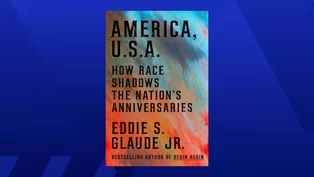
NewBook traces American celebration of freedom and denial of it
Video has Closed Captions
New book explores America's history of celebrating freedom while excluding millions (6m 56s)
 New
NewHow Israelis are responding to Trump's Iran peace plan
Video has Closed Captions
How Israelis are responding to Trump's Iran peace plan (5m 14s)
 New
NewIran deal a strategic defeat for Israel, Mideast expert says
Video has Closed Captions
U.S.-Iran deal a 'strategic defeat' for Israel, Middle East expert says (5m 2s)
 New
NewMonica McNutt on the wait for a Knicks championship
Video has Closed Captions
Monica McNutt reflects on the decades-long wait for a Knicks championship (5m 45s)
 New
NewNews Wrap: Newsom says Trump ordering DOJ to investigate him
Video has Closed Captions
News Wrap: Newsom says Trump ordering DOJ to investigate him and wife (7m 13s)
 New
NewTrump hails Iran deal as G7 summit begins in Europe
Video has Closed Captions
Trump hails Iran deal as G7 summit begins in Europe (8m 58s)
Providing Support for PBS.org
Learn Moreabout PBS online sponsorship New Episode
- News and Public Affairs

Today's top journalists discuss Washington's current political events and public affairs.

- News and Public Affairs

FRONTLINE is investigative journalism that questions, explains and changes our world.

 New Episode
 New Episode
 New Episode
 New Episode
 New Episode
 New Episode
 New Episode
 New Episode
 New Episode
Support for PBS provided by:
Major corporate funding for the PBS News Hour is provided by BDO, BNSF, Consumer Cellular, American Cruise Lines, and Raymond James. Funding for the PBS NewsHour Weekend is provided by...