
Group targets campaign cash used for misconduct legal fees
Clip: 8/6/2026 | 6m 16sVideo has Closed Captions
Group pushes for ban on using campaign funds for legal fees in misconduct cases
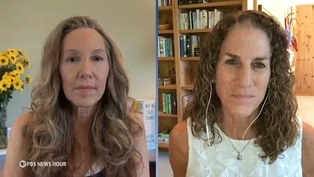
After Graham Platner ended his Senate campaign, activists launched an effort to claw back donations so the money wouldn’t be used on legal fees related to Platner’s alleged misconduct. The group behind the effort, Reckoning Action, is working with lawmakers to create a ban on using campaign cash for legal fees in sexual misconduct investigations. Liz Landers discussed more with Cheyenne Hunt.
Problems playing video? | Closed Captioning Feedback
Problems playing video? | Closed Captioning Feedback
Major corporate funding for the PBS News Hour is provided by BDO, BNSF, Consumer Cellular, American Cruise Lines, and Raymond James. Funding for the PBS NewsHour Weekend is provided by...
Group targets campaign cash used for misconduct legal fees
Clip: 8/6/2026 | 6m 16sVideo has Closed Captions
After Graham Platner ended his Senate campaign, activists launched an effort to claw back donations so the money wouldn’t be used on legal fees related to Platner’s alleged misconduct. The group behind the effort, Reckoning Action, is working with lawmakers to create a ban on using campaign cash for legal fees in sexual misconduct investigations. Liz Landers discussed more with Cheyenne Hunt.
Problems playing video? | Closed Captioning Feedback
Where to Watch PBS News Hour
PBS News Hour is available to stream on pbs.org and the PBS app.
Providing Support for PBS.org
Learn Moreabout PBS online sponsorshipGEOFF BENNETT: After high-profile assault allegations forced Democrat Graham Platner out of Maine's Senate race last month, questions about politicians' conduct are once again in the spotlight.
This week, North Carolina Republican Congressman Chuck Edwards announced he won't seek reelection after the House Ethics Committee recommended he be censured, citing what it called persistent and appropriate conduct toward two young female staffers.
AMNA NAWAZ: And a separate deadline to drop out looms for Ohio Republican Max Miller.
He's facing domestic abuse allegations from his ex-wife and says he is staying in the race.
Liz Landers has more on the efforts some advocates are taking to hold politicians accountable.
LIZ LANDERS: After Platner ended his campaign, activists launched an effort to claw back campaign donations, ensuring donors' money wouldn't be used to cover any legal fees related to Platner's alleged misconduct.
The group behind the effort, Reckoning Action, says it's trying to keep campaign cash out of what it calls the hands of predators.
Now the group is working with a bipartisan group of lawmakers to create a federal ban on campaigns using legal fees for sexual misconduct investigations.
Reckoning Action's founder, Cheyenne Hunt, joins me now.
Cheyenne, thank you for joining the program.
CHEYENNE HUNT, Founder and Executive Director, Reckoning Action: Great to be here.
LIZ LANDERS: You have worked in a lot of different ways, working with lawmakers, working with victims, going to reporters.
Why did this donor refund push feel like the right next step?
CHEYENNE HUNT: Well, one of the things that we have learned in this work is that, when survivors come forward, the support that they need doesn't stop after they tell their stories.
If anything, it multiplies because they're incredibly vulnerable to retaliation.
And we have seen that some of these bad actors use their campaign funds to go after survivors, not only with attorneys and tying them up in legal battles, but also with private investigators that can be incredibly intimidating.
And that can send those survivors into a situation where they feel muzzled, even though they have come out and spoken their truth.
And so this was something that we felt like we had to do.
And that's also why we're so incredibly proud to be working with Congressman Khanna and Representative Anna Paulina Luna on this bill to close the loophole.
But until we're able to make it illegal for campaign funds to be used against survivors in this way, we had to do what we could and were willing to get kind of scrappy.
And that was why we sent out this message and tried to help ensure that Platner donors knew that they had a way to get their money back and ensure that that donation that was given to a candidate they believed in, in the service of democracy wasn't going to get turned on brave survivors who came out and told the truth.
LIZ LANDERS: As you mentioned, this is not hypothetical.
Former Congressman Eric Swalwell has already spent tens of thousands of dollars in campaign funds on his own legal defense after those misconduct allegations forced him out of the California governor's race.
How have women been impacted here in this legal effort?
CHEYENNE HUNT: Across the board, we see survivors who are really the front line of this work and they face incredible retaliation.
And it's been so difficult for us.
But part of the reason Reckoning Action was formed was to make this painful for these perpetrators and to dismantle the systems that produce and protect them.
LIZ LANDERS: Do you have a sense of how much money people have gotten back in those campaign donations after you have launched this effort?
CHEYENNE HUNT: It's hard to tell because of the way that the FEC filing disclosures work.
We know that many Swalwell donors have gotten tens of thousands of dollars back, it seems, at this point in refunds.
For Platner, we don't know yet.
We sent that text out just after the latest FEC filing deadline.
So we will know in a few months.
However, I can say that we got hundreds of hits on our landing page with the instructions to get your money back.
And so I can assume we have taken a pretty good chunk out of that war chest.
LIZ LANDERS: You mentioned those two congressional offices that you're working with, Congressman Ro Khanna and Congresswoman Anna Paulina Luna, on that bill to ban this practice altogether.
If it passes, how does this actually change things for survivors?
CHEYENNE HUNT: It ensures that campaign funds cannot be used to cover up misconduct and to silence and to muzzle survivors who are coming forward for the greater good.
And so it makes sure, one, that the money can't be used that way, and, two, that there's no way to hide if the money is being used that way.
It requires these candidates and their campaign teams to disclose what their legal funds are being used for, right?
We have seen candidates who use their legal funds and their attorneys' offices as a go-between to do things like hire private investigators.
And so it also makes sure that they can't get away with that either.
And we're bringing all of these really shady practices into the light.
LIZ LANDERS: You have spent this year mostly involved in cases on the Democratic side like Swalwell and Platner, but right now it is Republicans who are in the spotlight.
Congressman Chuck Edwards just dropped his reelection bid after the House Ethics Committee found that he had harassed two young staffers.
Congressman Max Miller is facing domestic abuse allegations that he denies, and he is refusing to step down.
And then Congressman Cory Mills is also still under investigation for allegedly assaulting a girlfriend and cyber-stalking another woman.
Speaker Mike Johnson has declined to publicly call on Miller or mills to step aside, saying that there is a process.
REP.
MIKE JOHNSON (R-LA): I mean, the allegations are serious.
I think Max is taking them seriously.
I think our colleagues are.
But, again, we have to allow this process to play out.
It's just begun.
LIZ LANDERS: That is a notably different approach than how your party handled Swalwell and Platner.
Do you think that Republicans are being held to a lower standard here?
CHEYENNE HUNT: Absolutely, they are.
I mean, I think that they are invoking this language that suggests that what we're talking about is a process in a court of law.
But we're not.
We're talking about the people that deserve to represent us in the highest offices in the land.
It is an entirely different standard.
And people who are comfortable with violence against women and people who are willing to sweep that under the rug for their own political agendas don't deserve to hold those seats of power.
LIZ LANDERS: Cheyenne Hunt, thank you for joining the "News Hour."
CHEYENNE HUNT: Thank you.

FAA investigating jet takeoff during Marine One flight
Video has Closed Captions
Plane takeoff during Marine One flight renews concerns about D.C.'s busy airspace (5m 10s)

Greece uses satellite detection system to combat wildfires
Video has Closed Captions
Greece deploys satellite detection system to combat deadly wildfires (9m 10s)

Head Start faces major changes under Trump proposal
Video has Closed Captions
A look at the major changes Head Start faces under Trump proposal (7m 5s)
How American English evolved from its British roots
Video has Closed Captions
How American English evolved from its British roots (4m 25s)

How summers by the sea shaped three great American painters
Video has Closed Captions
Exhibition reveals how summers by the sea shaped three great American painters (5m 59s)
Murder trial put postpartum psychosis in spotlight
Video has Closed Captions
What is postpartum psychosis? The condition at the center of Lindsay Clancy's murder trial (7m 36s)
Providing Support for PBS.org
Learn Moreabout PBS online sponsorship
- News and Public Affairs

FRONTLINE is investigative journalism that questions, explains and changes our world.
 New Episode
- News and Public Affairs

Today's top journalists discuss Washington's current political events and public affairs.

 New Episode
 New Episode
 New Episode
 New Episode
 New Episode
 New Episode

 New Episode
 New Episode
Support for PBS provided by:
Major corporate funding for the PBS News Hour is provided by BDO, BNSF, Consumer Cellular, American Cruise Lines, and Raymond James. Funding for the PBS NewsHour Weekend is provided by...