
Feb. 17, 2026 - Full Show
2/17/2026 | 26m 48sVideo has Closed Captions
Watch the Feb. 17, 2026, full episode of "Chicago Tonight."
Remembering the Rev. Jesse Jackson. We discuss the life and legacy of the civil rights icon and former presidential candidate.
Problems playing video? | Closed Captioning Feedback
Problems playing video? | Closed Captioning Feedback
Chicago Tonight is a local public television program presented by WTTW
WTTW video streaming support provided by members and sponsors.
Feb. 17, 2026 - Full Show
2/17/2026 | 26m 48sVideo has Closed Captions
Remembering the Rev. Jesse Jackson. We discuss the life and legacy of the civil rights icon and former presidential candidate.
Problems playing video? | Closed Captioning Feedback
How to Watch Chicago Tonight
Chicago Tonight is available to stream on pbs.org and the free PBS App, available on iPhone, Apple TV, Android TV, Android smartphones, Amazon Fire TV, Amazon Fire Tablet, Roku, Samsung Smart TV, and Vizio.

WTTW News Explains
In this Emmy Award-winning series, WTTW News tackles your questions — big and small — about life in the Chicago area. Our video animations guide you through local government, city history, public utilities and everything in between.Providing Support for PBS.org
Learn Moreabout PBS online sponsorship>> Hello and thanks for joining us on Chicago tonight.
I'm Brandis Friedman.
>> Tonight the country is mourning a civil rights icon.
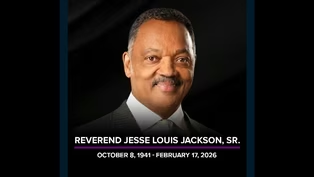
Reverend Jesse Jackson has died at the age of 84 for decades.
Jackson fought for communities of color on issues like voting rights and job opportunities after sharing his Parkinson's diagnosis in 2017, he continued to make public appearances and run his rainbow push organization until stepping down in 2023.
But late last year, his doctors confirmed the diagnosis of super super a nuclear palsy, a life-threatening neurological disorder.
Here's a look at just some of his journey.
>> If that event it down if it is from burning, we have a movement here Chicago.
A B and church tonight.
>> From Martin Luther King Junior.
>> To President Barack Obama.
>> Reverend Jesse Jackson's 84 years span generations from the civil rights movement to the nation's first black president.
And so much history in between.
Jackson was born in 1941.
In Greenville, South Carolina, as a student at the historically black university, North Carolina, a and T he led siddons at whites only lunch counters and became immersed in a burgeoning civil rights movement eventually joining the march from Selma to Montgomery, led by Reverend King.
King eventually dispatched the young Jackson to Chicago to run operation breadbasket and economic campaign pressuring white businesses to hire black workers.
4 years later, Jackson stood outside the Lorraine Motel as he and other icons of the movement witnessed King's assassination.
heard from home.
>> We to you is one of those different Moment for become like come before another King.
All that stuff happened within a split second.
>> But after the assassination, when Jackson returned to Chicago, other King AIDS criticized him for wearing a sweater, supposedly soaked with King's blood for 2 days after the shooting.
In 1971, Jackson formed operation push on Chicago's South side with a mission to register voters in communities of color nationwide and diversify the workforce.
He would again write his name in the history books with not one but 2 campaigns for president.
>> The second run in 1988, winning 13 primaries and caucuses for the Democratic nomination.
>> We must that was the red out.
hope alive.
>> More than any other black politician.
until Barack Obama I don't think I and many other people realize to what extent.
>> Jesse Jackson paved the way, not just in the tactics of politics.
You know, the delegates in all of that stuff.
That sounds very wonky to a lot of people, but also in the message in the vision that he had of unity in a Democratic coalition of using all the different parts of the rainbow of America and putting them together in one political party.
He was largely responsible for that.
And frankly, in the 1980's.
No one realized that because it wasn't until Barack Obama became president that I think people started to realize, oh, wait, Jesse Jackson actually did something that lasted beyond those 2 campaigns.
>> Over the years, Jackson continued his fight for voting rights and to register as many people as he could.
He exerted influence abroad garnering the release of hundreds of captives and at-home standing with families like those of Ahmaud Arbery.
The black jogger killed by 3 white men in Georgia in 2021.
Jackson was known for his flair with words, his unmistakable cadence, so much that he even got in on the joke of it.
On a 1983 episode of Saturday Night Live.
>> You do not like green eggs and ham.
I do not like I am.
>> Though sometimes his words got him in trouble as when he apologized for using a derogatory reference to the Jewish population of New York in 1984. and in 2008 complaining that candidate Barack Obama was, quote, talking down to black people.
The ordained minister also acknowledged fathering a daughter outside of his marriage with one of his rainbow push employees.
In 2018.
We have a chance to ask him about his own legacy.
What do you think your legacy will be?
Reverend Jackson?
>> as of salt to continue the service.
person of faith.
For years, most frightened just law.
>> Even then he was still focused on what more he could do out time has come.
>> We've come from disgrace.
Grace.
Has come.
Give me your tired.
Give your pool, your huddled masses who united the breathe free and come November.
change.
It out of time.
Has Tom >> Jackson leaves behind his wife of 63 years.
Jacqueline Jackson and their children, San T to Jesse Junior.
Jonathan Yousef and Jacqueline as well, Jacqueline, yes, another Jacqueline as well as daughter Ashley Jackson and grandchildren.
In a statement, the family says, quote, Our father was a servant leader not only to our family, but to the oppressed, the voiceless and the overlooked around the world.
We ask you to honor his memory by continuing the fight for the values he lived by the Rainbow Push.
Coalition says public observances will be held here in Chicago and that details will be shared in the coming days.
And reactions are pouring in today.
In a statement, Mayor Brandon Johnson says, quote, I am devastated to lose my mentor and friend Reverend Jesse Jackson.
Senior.
We honor him and his hard-earned legacy as a freedom fighter, philosopher and faithful Shepherd of his family and community here in Chicago.
Former President Barack Obama says for more than 60 years, Reverend Jackson helped lead some of the most significant movements for change in human history.
Michelle got her first glimpse of political organizing at the Jacksons Kitchen table when she was a teenager.
And in his 2 historic runs for president, he laid the foundation for my own campaign to the highest office of the land.
Andre Show Social President.
Donald Trump posted in part, quote, I knew him well long before becoming president.
He was a good man with lots of personality, grit and, quote, street smarts.
He was very gregarious.
Someone who truly loved people.
He had much to do with the election without acknowledgement or credits of Barack Hussein Obama, man who Jesse could not stand.
And president of the Chicago Teachers Union and Illinois Federation of Teachers, Stacy Davis.
Gates says, quote, he marched with educators, students and families.
He walked picket lines.
He fought for the schools, our children deserve his leadership.
Expanded the map a possibility.
There's more reaction on our website.
You can find it at W T Tw dot com slash news and you can get more reaction by staying right here because up next, a look at the life and legacy of Reverend Jesse Jackson and has deep roots in Chicago with some who knew him.
Well, stay with us.
>> Chicago tonight is made possible in part by the Alexander and John Nichols family.
The Pope Brothers Foundation.
And the support of these donors.
>> Reverend Jesse Jackson's legacy runs deep in Chicago.
He left his mark on generations of politicians.
Clergy members, organizers and everyday folks joining us to talk about Jesse Jackson.
Our 0th Ward Alderman William Hall, who represents communities like Chatham, Auburn, Gresham in parts of Inglewood, Reverend, Jeanette Wilson, senior adviser to Reverend Jackson of the Rainbow Push Coalition and Kevin Boyle, professor of American history at Northwestern University welcomes all 3 of you.
Thanks for joining My condolences.
I know that you're very close to Reverend Jackson rebel Wilson.
I want to start with you as we watch that obit package and sort of a look back over some of the year's.
What what comes to mind for you where your favorite memories?
Well, Reverend Jackson continue the legacy that Doctor King live.
>> He began his ministry talking about the poor people's campaign.
He became mayor Resurrection City leaving what Dr King started on his last birthday.
A campaign to have the nation look at the plight of poor people, ground black.
Why yellow?
All of those poor people met Reverend Jackson in DC that came a trends and across the country fighting for fair housing, fighting for a livable wage fighting for.
Access to health care for themselves and for their children.
So he started various the prophetic voice that plot for everyone we believe really believe in this rainbow coalition Prague for students to have a high-quality public education at every level of the educational scale who profit teachers to be certified in the city of Chicago.
He fought for access for business people to have access for their products to be on store shelves.
fought for consumers understand the buying power that we have he would tell corporations represent 10% of your market.
You owe us temper some your jobs and contracts.
You fought that all around the nation and fight for freedom in America abroad.
He met Nelson Mandela.
Robbins island prison.
He was with Nelson Mandela when he was released because he fought to end apartheid.
He was with Mandela when he became president.
He went to countries all over the world, freeing hostages.
We often said if we ever traveled, we don't worry about it because we said something happened, Reverend Jackson coming together when Ivan, how you devil to have a good one I was able to look at him.
Reverend Jackson went and rescues.
is there are memories that you have of him that really illustrates what he means to people to anyone.
>> I want to talk a Mississippi, which is where tone the use caution of strip or city in America.
They didn't have a sewage, cleanup problem.
They didn't have running water, clean water filtration.
>> For jets and walked into this little house, one room house with a lady sitting in the middle of the room, Welch's everywhere.
It a smell believe in Mississippi, which is now part of a gamble.
And this is unfair with this one months in South, living like garbage was strong in the ditch from her home.
And so she she couldn't access to have access to health care, shouldn't have access clean water.
And painted a picture of her for the world to see.
So America would have to fix He says that's not right.
Nobody else been to the house.
No government, no County board, president.
He was on the candidate at that time.
Want to marry?
Prophetic Voices said this is not right for people to live like >> Alderman Hall, how did you come to know him?
Well, I mean, first of all is her.
We were in the basement Rainbow shooting Sunday school on her son to school Balkans and she says to me, I think that you need to come back on Saturday and open up the broadcast.
Didn't know what the broadcast was.
Never heard older.
You are the time when I was moved.
Got about.
24 25 so young and I walk out the hallway with river Wilson is Reverend Jackson.
And she tells women Jackson that I'm going to be back on Saturday to open up the broadcast.
if you get a game next you know I I know what to do and our revenue with the nice it is not Miami you're getting ready to talk to the world and it was that moment that he allowed me to clear my throat and say something to the world and from that moment over for rest my life.
I always remember the world that he created for me show.
>> professor of oil.
What do you view as Reverend Jackson's most enduring contribution to American political as well as civil rights history?
think are 2 things that really stand out to me.
>> The most obvious one is he was this transformational figure who is a bridge between that extraordinary generation.
Took the civil rights movement into its greatest breakthroughs and then the age of Obama at the other side, he's the bridge between those.
He's the man who made it possible 4 Americans transition from Jim Crow, America.
Barack Obama's America.
I think your story so powerful that the other side of Jesse Jackson story that I think deserves so much.
More attention.
Is being a voice for people Had every reason to believe in this society that they didn't have a voice, the ability to.
Give people who had reason to have no hope in this nation.
Hope in this nation.
I thought it was a really powerful thing to People say that he was a great patriot.
Because, of course, that's the very definition of patriotism that you represent.
What's best in the American promise.
And become a voice for people.
To share in that hope.
>> Alderman Hall, Reverend Jackson was both a faith leader and politician.
Lots of other things is he's we've discussed rebel Wilson you share those 2 things as well.
You're in alderman as well as as a faith leader.
What lessons do you borrow from him?
Be it, you know, either in the church or working as an first, the best time you ever preaches to show and care for those need and that was the sum and that he preached when there was no camera.
>> That was the sum he preached 2 o'clock in the morning.
We got a phone call from someone who didn't have close because the home was burned out and that's a man is a summit that I'm still trying to preach, which is to show up and to care for those need it.
And Reverend Jackson did for all of us show us what the Bible look like.
His Representative Jackson, Jonathan said early in my daddy at heart as a minister.
And when I say to you that when it comes to the Bible, he lifted and many days on the flight days a long day in a car that Bibles right there in his hand and not only was he a student of the words, he was a student learned how to love.
And he showed that love and space is what most people say.
Don't go.
He sold a lot of people who didn't have a voice and not jus, you know, talking points that you will hear throughout the days.
That was his reality.
He believed in the mission in the Gospel of Jesus Christ.
And he didn't need a pulpit.
He didn't need the title.
He didn't need the congregation.
The world was his congregation in every continent.
Every step that he took was who do I show the good news?
good news is that you matter of good news is I'm here to help.
And I think that that message of hope was seen in his life that allowed gospel to not only come to life for those believed in the gospel.
He showed us what invisible got look like.
>> Reverend Jackson, he was known for his work, getting people involved and inspiring them.
network extended to young people.
Of course, in fact, people.
We have a clip of him on Sesame Street and early 70's.
Okay, we have a >> Some make a mistake.
Well, >> am somebody that was a classic rebel Wilson.
What do you what do you think when you when you see that?
>> Well, always wanted to relate to children who I had parents.
Some of them may be in jail.
Know maybe I had a mother didn't have a problem.
>> We Jesse Jackson was my 3rd night.
So you can be something I am somebody who would have people all around the country.
Every school he went to when he went to the tales were anywhere they raise your right hand.
I owe somebody believe in somebody in us and he's saying was if I could come from poverty.
Not living with my father, never lived with my Natural father had a stepfather.
I can do what I have done, was an all American athlete.
He was a valedictorian of his class.
He was head of the student Council.
He was on National Honor Society.
graduated with honors from North Carolina and 2, if I could do all of that, some So you may be poor.
But you asked somebody and he had that little little bit.
He took to he went to prison, a jail school, church everywhere he traveled in the world.
That was his rhythm.
Helping people understand have to be proximate to the needs of people.
You can help if you don't, if not near me.
whole talk a little bit his flair as We know that he had a flair for fashion for speaking.
He loved meeting people.
>> And that's because he was light as many dark moments as he had personally.
You can tell when he was going he didn't dress like he was going through.
He didn't show up like he was going to because that's how selfless he was.
And I think that.
The flare that he had was the light needed in dark spaces.
It was the joy that people needed.
And that's one of the things always remember about him.
That flare wasn't just for the cameras.
It was for the doorman.
It was for the made.
It was for the pilot.
It was for the person selling newspapers.
He mission.
He was driven by mission to give so somebody else can gain something.
And that's what that flare represented was the endless well of joy and peace that he wanted everyone to get ahead of and gave it even when he should be kept it himself and days when we were sleepy was up many days when we were eating, he was fasting because he believed that if I can show up and give can somebody else will have what I might not had.
You mentioned some of those dark days, right?
Professor Boyle, Reverend Jackson, Reverend Jackson's career, not without controversy, right?
When you when you've lived and worked as long as he has.
>> How navigate the criticism he received?
>> Obviously, there was a good bit of criticism in various points in his life.
I think one way, I think what he did was pushed through with that criticism, try to learn from it, try to adjust to it.
I think the really big point I was reading the he's a bit worried this morning.
I got up and saw news.
And it bothered me.
How much of that criticism worked its way into?
This is the New York Times obituary morning because it seems to me that to say that anybody a public figure and ordinary person is imperfect.
Say they're human.
Have a read Jackson often said.
>> When he did, you let he said, don't judge by my just about the box score.
You have to weigh good and the bad.
when you look at all of that, that happened in his life, the good far outweighs the bad and everybody has moments where you're not perfect.
He was perfect man who was a present person who was prophetic voice and he didn't allow his family to hurt anyone else.
He took it and can't move it.
We still laugh at him all the time because he he would just get up and cable.
We will be sad, tired.
We've got to go.
Got to go to the next He never let those moments.
Bury him.
He see you need.
that's going try to me tell you when God tie.
Robyn Goodman, no one was looking for that man.
And then we'll some of the hostages that he brought back.
We didn't even know they will hostages.
And so he just kept going for me and all.
The interesting thing is that he never had hate in his heart.
I've been >> Moments with him meetings on a roll with him and which Reverend argued we had.
right to literally destroy someone's career.
He had a right to, you know, say something very damaging to them.
But he never Was he disappointed moments?
Was he hurt at moments?
Did he share tier 2 moments?
Yes, but he never returned evil with evil.
And I think that that level with next standard of of compassion is what makes the world heavy today is because she returned compassion and love and the presence of hate bigotry and the presence of people who smelled in his face.
But all the time they want to take his place.
And for me to see him take knives out of his bag and 2 walk out of rooms knowing that that was not a room that they wanted me in and to never stop.
Not because he have anything else to do, but because he believed that love can conquer hate, believe wholeheartedly that love can change the world and he lived it.
>> he didn't do it from even tougher You know, some people want the states so that they can be recognized.
He didn't do it for that reason.
He was trying articulate somebody else's pain so that we can address it and fix it.
You know, he's one of the dew points of that.
I know he then where a lot of jewelry.
He didn't wear a lot of fancy clothes.
We all his struggle close to 3rd marching close Professor River Jackson.
He's in the running out of time.
I want to talk about this.
He's recognized as the first black presidential candidate to run a competitive race for major political party.
We mentioned the obit.
>> What are the barriers that he broke in 1988?
Oh, they're absolutely massive barriers and the most fundamental one.
>> Was just to prove that there was a base up substantial base of support for a man of color to run for the presidency United States.
That was something common assumption the United States political wisdom of United States as it is not going to be black president as United States for decades and decades to come.
He proved that was entirely possible.
And that he created a language in his campaigns that it carries into the present day progressive politics in this really powerful direct way.
And then we're looking at what appears to be the memorial that has that has appeared outside Rainbow push headquarters on the South side.
Really >> for this one to you.
What do you think the next generation should carry forward from his life's I think the next generation and now generations so up and serve.
>> He spoke up when they told him to shut up.
He stood up when they told him to sit out the celebrity of him was not lights, camera action.
It was the fact that you can see him working.
And I believe that our generation as rebel Meeks said he left a lot on the field.
He gave us a lot of the blueprint.
So let's continue the protests.
Let's continue identify problems and let's change the policy.
can do that if we just show up in pick up the ball and run, that is where we're going to leave My thanks to all of you Alderman William Hall professor Kevin Boyle and redemption at Wilson.
Thank you so Thank you.
And we're back to wrap things up right after this.
>> Reflecting the people and perspectives that make a buck This story is part of Chicago tonight.
Black Voice.
>> And that is our show for this Tuesday night.
We are a month out from the primary election in Illinois.
Be sure to check out our online voter guide to learn more about the candidates who are running, what the officers do as well as where when and how you can vote.
You can find it at W T Tw dot com Slash voter guide and join us tomorrow night at 5, 30 10 Governor JB Pritzker is set to deliver his budget address.
We're live in Springfield with analysis and reaction now for all of us here in Chicago Brandis Friedman, thank you for watching.
Stay healthy and safe and have a good night.
>> made possible.
By Robert.
and Clifford A Chicago
 New
NewCivil Rights Leader the Rev. Jesse Jackson Has Died at 84
Video has Closed Captions
Clip: 2/17/2026 | 7m 47s | He advocated for the poor and underrepresented on a wide range of issues. (7m 47s)
 New
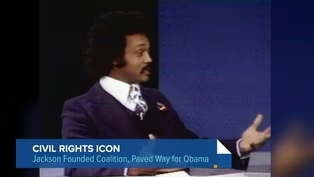
NewReflecting on the Life and Legacy of the Rev. Jesse Jackson
Video has Closed Captions
Clip: 2/17/2026 | 16m 52s | Despite profound health challenges in his final years, Jackson continued protesting. (16m 52s)
Providing Support for PBS.org
Learn Moreabout PBS online sponsorship
- News and Public Affairs

Top journalists deliver compelling original analysis of the hour's headlines.

- News and Public Affairs

FRONTLINE is investigative journalism that questions, explains and changes our world.












Support for PBS provided by:
Chicago Tonight is a local public television program presented by WTTW
WTTW video streaming support provided by members and sponsors.