
December 21, 2025 - PBS News Weekend full episode
12/21/2025 | 26m 45sVideo has Closed Captions
December 21, 2025 - PBS News Weekend full episode
December 21, 2025 - PBS News Weekend full episode
Problems playing video? | Closed Captioning Feedback
Problems playing video? | Closed Captioning Feedback
Major corporate funding for the PBS News Hour is provided by BDO, BNSF, Consumer Cellular, American Cruise Lines, and Raymond James. Funding for the PBS NewsHour Weekend is provided by...
December 21, 2025 - PBS News Weekend full episode
12/21/2025 | 26m 45sVideo has Closed Captions
December 21, 2025 - PBS News Weekend full episode
Problems playing video? | Closed Captioning Feedback
How to Watch PBS News Hour
PBS News Hour is available to stream on pbs.org and the free PBS App, available on iPhone, Apple TV, Android TV, Android smartphones, Amazon Fire TV, Amazon Fire Tablet, Roku, Samsung Smart TV, and Vizio.
Providing Support for PBS.org
Learn Moreabout PBS online sponsorshipJOHN YANG: Tonight on PBS News Weekend, U.S.
Pressure mounts on the Maduro regime as the Coast Guard goes after another oil tanker off the coast of Venezuela.
Then the rising costs of medications and the devastating consequences when health coverage falls short.
And a look at holiday festivities and traditions from around the world as Christians prepare to celebrate Christmas.
MAN (through translator): All Nativity scenes depict Jesus as scripture dictates.
The Krakow Nativity scene, however, differs from all of them in that Christ is born in a palace fabricated completely in the minds of the Nativity scene makers.
(BREAK) JOHN YANG: Good evening.
I'm John Yang.
President Trump's pressure on Venezuelan leader Nicolas Maduro mounted today as the Coast Guard went after another oil tanker that U.S.
officials say was helping Venezuela get around sanctions.
If they intercept it would be the third time in less than two weeks and the second time this weekend.
Yesterday, the Coast Guard stopped and boarded a Panamanian flag tacker carrying Venezuela crude oil to Asia.
Venezuela called it theft and hijacking.
Last week, President Trump announced a total and complete blockade of all sanctioned tankers headed to and from Venezuela.
Idrees Ali is the national security correspondent for Reuters.
Idrees, what do we know?
What's the latest?
What do we know about today's pursuit?
IDREES ALI, National Security Correspondent, Reuters: Yeah, this has been a pretty busy weekend when it comes to Coast Guard activity around Venezuela.
And so what we know basically is that earlier today on Sunday, the U.S.
Coast Guard, with help from the U.S.
Navy, tried to interdict a vessel that was sanctioned by the United States and has historically carried oil to and from Venezuela.
The latest reporting we have is that this pursuit is still ongoing because the vessel in question has not given up, has not allowed them to come on board.
And so it's a pretty active situation.
We don't know how it's going to get resolved.
But it is international waters, it is sanctioned.
And so it's pretty much in line with what President Trump said the U.S.
would be doing, which is going after sanctioned oil tankers that are carrying oil to and from Venezuela.
JOHN YANG: This all started with drug boats in the Caribbean and the eastern Pacific.
But how much of an escalation does this represent?
IDREES ALI: You know, from the officials I've talked to and the experts we've talked to, this does represent an escalation because it's one thing to be striking suspected drug boats that are in and around Venezuela.
It's another thing to really put pressure on the economic lifeline of Venezuelan President Maduro, and that's oil.
It's really one of the few things that brings in money for the government.
And when you go after that, you're really sending a message that this isn't just about drug boats, drugs.
It's about cutting off really, you know, the scarce resources Maduro relies on.
And it really sends a message, I think, to the Venezuelan government and people that the United States is really focused not just on, you know, going after drugs, but potentially getting rid of Maduro.
And I think we're seeing that in action.
JOHN YANG: What's the legal basis or international law basis for what the administration's doing?
IDREES ALI: So much like most legal things, there is a debate, and not everyone agrees on what the legal basis is.
So by definition, the Coast Guard has different authorities.
And so they do have the authority to go after stateless vessels or vessels that they suspect are carrying goods like narcotics and to really check the registry.
So the Coast Guard has quite a bit of leeway.
That's what the administration is saying.
Look, these are vessels that the U.S.
has sanctioned.
They could be carrying dangerous goods, and they're carrying sanctioned oil in many cases, or that's the allegation.
Legal experts disagree.
They say just because a vessel is sanctioned by a country does not mean that you can board it.
And so there's a legal sort of real jostle going on right now.
And, you know, it really comes against the backdrop of what the precedent might be, right?
So if you have the Chinese sanctioning a vessel, you know, U.S.
or allied, and they say, look, we're going to go board this vessel because it's sanctioned, I think legal experts are saying, look, you can't have that.
The rules sort of based international order doesn't allow that.
So there's a real debate about what the legal basis is.
And, you know, again, the whole campaign we've seen since September has been legally questionable.
You know, the strikes against suspected drug vessels has really been under a microscope when it comes to legalese.
You know, can you really strike a boat that's carrying maybe drugs?
Can you really kill someone for that?
And most legal experts think no.
JOHN YANG: Are all three shifts involved in this?
Are they all on the sanction list?
US Sanction list.
IDREES ALI: So the first one was on the sanction list.
The one today is Sunday is also on the sanction list.
The one on Saturday was interesting because actually it was not on the sanction list.
It was what is known as a shadow vessel.
So it's not sanctioned, but it's a vessel that is essentially spoofing its location, changing its name, changing its location to get around some of the restrictions.
But it was not sanctioned.
And I think that's what raised a lot of eyebrows for people.
The administration said, well, it might not be sanctioned, but it's carrying sanctioned oil.
That wasn't what President Trump had said would be happening.
He said the U.S.
would be going after sanctioned tankers.
And so two out of three met the criteria.
The one yesterday on Saturday did not.
And I think that's raising a lot of concerns because some of that oil was destined for China.
So I think the Chinese government is going to have a lot to say about that.
JOHN YANG: In about 45 seconds we have left as President Trump talks about taking this onshore in Venezuela.
Remind us what the military buildup has been like in the region.
IDREES ALI: Yeah, the military buildup has been huge.
You know, in the past week, we have seen the administration, you know, really lay out its strategy and its national security strategy documents, saying they want to return to the Monroe Doctrine, which is basically saying the U.S.
is going to look after the Western Hemisphere, every other country should stay out.
And to that end, they have deployed an aircraft carrier, about 20 F-35 jets, and at least 11 other warships.
And so the buildup is just massive.
It's not something you see just for strikes against suspected vessels or going after sanctioned oil tankers.
It really is if you are looking to change not just a regime, but really the way the Western Hemisphere currently is and how the US Is interacting with it.
JOHN YANG: Idrees Ali of Reuters, thank you very much.
IDREES ALI: Thanks for having me.
JOHN YANG: In today's other headlines, at least 16 of the Epstein files released Friday have disappeared from the Justice Department's website.
One of them was a photograph of an array of pictures in a desk drawer, including one of President Trump.
The Justice Department said the materials continue to be reviewed and redacted.
On NBC's Meet the Press today, Deputy Attorney General Todd Blanche said it was not an attempt to shield Mr.
Trump.
TODD BLACHE, Deputy Attorney General: We don't have perfect information.
And so when we hear from victims' rights groups about this type of photograph, we pull it down and investigate.
We're still investigating that photo.
The photo will go back up and the only question is whether there will be redactions on the photo.
JOHN YANG: Blanche has said that in the coming weeks, more material will be released.
About a dozen gunmen opened fire at a pub in South Africa, killing at least nine people and wounding 10.
There's no known motive.
The bar is in an area west of Johannesburg where illicit mining operations have led to a rise in gun violence.
It's the second mass shooting in South Africa in three weeks.
The country has one of the highest homicide rates in the world.
It's been a week since that mass shooting in Australia targeting a Jewish celebration at the iconic Bondi Beach.
Today, more than 10,000 people gathered to support the Jewish community and remember the 15 victims of the attack.
The crowd paused for a minute of silence at 6:47 p.m.
the exact time the massacre began.
And today is the winter solstice, the first day of winter and the day with the year's shortest period of daylight.
As the sun rose this morning around the world, there were celebrations.
At Stonehenge, thousands of people cheered and danced.
And in the Egyptian city of Luxor, visitors stood watch as the sun aligned with the axis of ancient temple.
After today, daytime will get a little longer each day.
Still to come on PBS News Weekend, schools using hip hop to teach social emotional skills and how Christians around the world are celebrating this Christmas week.
(BREAK) JOHN YANG: Year-end polls in the last couple of weeks have all reported that the rising cost of health care is among Americans biggest worries.
Insurance coverage for prescription drugs has been decreasing as their prices have been increasing.
As PBS Wisconsin's Marisa Wojcik learned, not all health plans are created equal.
MARISA WOJCIK (voice-over): Cole Schmidtknecht was just 22 years old when he was rushed to the ER by his roommate.
Unable to breathe.
BILL SCHMIDTKNECHT: When he arrived at the hospital, he was lifeless.
Yeah, no pulse.
They had to resuscitate him.
MARISA WOJCIK (voice-over): By the time his parents, Bil and Shanon Schmidtknecht, got to Cole's bedside, doctors had shattering news.
BIL SCHMIDTKNECHT: What we got told just simply that he would never wake up.
SHANON SCHMIDTKNECHT: What we saw laying in the hospital of our son was all that he would ever be.
MARISA WOJCIK (voice-over): Cole had suffered a devastating asthma attack.
For his parents, the cause of death only added to their stunned disbelief.
SHANON SCHMIDTKNECHT: He was on a great medication that stabilized his asthma for the past decade or more.
So were like, this cannot be like an asthma.
MARISA WOJCIK (voice-over): As they tried to piece together Cole's final hours, his roommate remembered that Cole did go to the pharmacy days before he died.
SHANON SCHMIDTKNECHT: His roommate had said, I don't know.
We tried to get it a few days ago and he couldn't afford it.
It was like $500.
MARISA WOJCIK (voice-over): That price shocked Cole's parents since his copay had always been less than $70.
But what they didn't realize was that a recent shift in how his company provided health coverage would cause without any notice, the out of pocket price of the inhaler.
He needed to skyrocket 800 percent, well beyond his budget.
What was the shift?
His employer had moved from traditional health insurance to a form of coverage known as a self-funded health plan.
Millions of Americans get their coverage this way.
But health advocates say patient confusion and ignorance about the subtle differences between these two types of coverage can have devastating impacts for patients like Cole.
SHANON SCHMIDTKNECHT: You love to play.
I will never forget that.
Leaving that pharmacy and being like, oh my God, this is what happened to Cole.
KEVIN VOLTZ, Cancer Patient: It just gets old after a while.
MARISA WOJCIK (voice-over): Kevin Voltz ran into similar problems with his self-funded health plan.
In his case, he was battling chronic lymphocytic leukemia, a type of blood cancer.
KEVIN VOLTZ: All of a sudden, my numbers were at like 167,000 compared to like 4 or 5,000.
MARISA WOJCIK (voice-over): He was in urgent need of treatment.
His oncologist had a prescription, was promising, but would come at a price.
KEVIN VOLTZ: We need $13,000 before we could ship this.
And I said, $13,000?
Yes, that's what this drug costs to be delivered without insurance.
MARISA WOJCIK (voice-over): $13,000 per month.
Kevin's self-funded health plan wouldn't cover a dime of the medication, calling it a non-preferred specialty drug, which meant he was on the hook for 100 percent of the cost, nearly $100,000.
KEVIN VOLTZ: Nobody can do that.
I don't care who you are.
MARISA WOJCIK (voice-over): His medical care team sent appeal after appeal, pleading with his health plan to cover some portion of his medicine.
KEVIN VOLTZ: I got lots of denial letters and stuff over the months saying that there was nothing they could do and I'm running low on my month's supply and what am I going to do next month?
MARISA WOJCIK (voice-over): Traditional, fully insured health plans are supposed to ease those kinds of fears.
They must follow all federal and state laws, including notifying patients of changes to their prescription coverage and limiting how much a patient can be forced to shoulder out of pocket.
By contrast, self-funded health plans like Schmidtknechtes and Kevin Voltzes are regulated only under federal law, not state insurance laws, which are usually more stringent.
SARAH DAVIS, Center for Patient Partnerships: A self-funded plan is not insurance.
MARISA WOJCIK (voice-over): Sarah Davis is the director of the Center for Patient Partnerships, a research and advocacy program at the University of Wisconsin, Madison.
She says it's often difficult for people to even know what kind of plan they have.
SARAH DAVIS: It takes advocates and patients sometimes quite a bit of time to parse out and figure out that it is not insurance if there are claims being denied.
The protections that consumer has are reduced in self-funded plans.
MARISA WOJCIK (voice-over): In recent years, these self-funded plans have become the most predominant form of employer provided health coverage in the United States.
Some 63 percent of plans are self-funded.
Why the gross?
As healthcare costs rise, these plans save employers money by offering greater cost control and flexibility compared to traditional insurance.
MIKE ROCHE, The Alliance: Self-funding lets the employer take control of the second or third biggest line item on their budget.
The last few years that's been a double digit increase.
MARISA WOJCIK (voice-over): Mike Roche is the director of business development at The Alliance, a Wisconsin organization that helps design self-funded health plans for companies across the Midwest.
MIKE ROCHE: What employees need to know is that your employer has now become the insurance company.
MARISA WOJCIK (voice-over): After exhausting nearly every possible avenue to pay for his cancer medicine, Kevin Voltz received good news from his clinic's drug insurance specialist.
KEVIN VOLTZ: She kept calling me and calling me.
She couldn't tell me the news fast enough that they had come through.
MARISA WOJCIK (voice-over): The drug manufacturer informed the clinic they would provide the remaining dosage of his treatment at no cost, but did not provide an explanation.
BIL SCHMIDTKNECHT: Please don't let another parent stand where we are today.
MARISA WOJCIK (voice-over): One year after their son's passing, Bil and Shanon Schmidtknecht are still searching for answers and advocating for change.
SHANON SCHMIDTKNECHT: The fact that someone has to pass away because he can't afford his medication in the United States of America is unacceptable.
BIL SCHMIDTKNECHT: The ultimate thing.
No matter what happens, it was totally preventable.
I mean like it was preventable.
SHANON SCHMIDTKNECHT: This cannot happen.
This cannot happen to another family.
MARISA WOJCIK (voice-over): For PBS News Weekend, I'm Marissa Wojcik in Madison, Wisconsin.
JOHN YANG: Nationwide schools are looking for better ways to connect with students and support their emotional well-being.
A recent Yale University study found that social emotional learning programs or self can improve students' sense of belonging and boost academic performance.
While Black and Brown students are more likely to report feelings of isolation from their peers, many SEL models don't reflect their lived experiences.
A Baltimore based organization called We Do It 4 the Culture is changing that it uses hip hop and storytelling to help students learn empathy and express themselves.
Ali ROgin spoke to Jamila Sams, the founder of We Do It 4 the Culture.
ALI ROGIN: Jamila, it's so nice to talk to you.
Many teachers say that the pandemic exacerbated many students' feelings of loneliness.
So what were you hearing from them that made you realize that there was a gap in social emotional learning that needed to be filled?
JAMILA SAMS, Founder, We Do It 4 the Culture: What we're seeing in terms of the research around social emotional learning and what happens when social emotional learning is not centered and is that since the pandemic about 61 percent of our young people are saying they do not feel a sense of belonging in school and that's on a national level.
Currently the United States is experiencing its lowest academic levels in 30 years.
And so when we think about social emotional learning, the art of not only naming our emotions, but managing our emotions and leveraging our emotions for positive changes.
When students do not feel a sense of belonging, when they do not feel as though their identities and their cultures are being centered in an academic space, then they become disconnected.
And as a result, those are some of the statistics that we're dealing with right now.
ALI ROGIN: And your program is now in more than 150 schools across 16 states.
Can you walk us through what a typical lesson looks like?
JAMILA SAMS: Absolutely.
So we try to anchor content that students are already engaging with, and we try to stay up to date with youth culture, pop culture, hip hop culture.
And so a typical lesson may involve looking at some lyrics from Kendrick Lamar and analyzing the lyrics to find the social emotional learning competencies that exist within those lyrics.
So, for example, students may find lyrics that relate back to self-awareness, self-management.
Lyrics may have a social awareness lens, and so they're able to extract that.
And so what we try to do is take content that they're already interested in, and what that does is it helps them to kind of take down their guard and open up and share their stories with their peers and adults.
ALI ROGIN: And I want to ask a little bit more about that, because hip hop has been such a powerful conduit for this learning.
How did you decide that this was going to be the structure around which you were going to build this program?
JAMILA SAMS: Yeah, I am what I would deem to be a certified hip hop head.
I've always loved and anchored hip hop culture.
I feel as though it's something that you live, not just something that you listen to.
And so hip hop has always been a space for emotional regulation, storytelling, and critical reflection.
So we do it for the culture.
Didn't create something new.
All we did is that we translated a language based on experiences that young people already have.
And so when students feel as though they could take down their guard, they're able to talk about things that relate to them, but then they're able to anchor it in something that they're already familiar with, then that's where the magic happens.
They take down their guard, they open up, they share their stories, and what they find is that they have so many things in common with their peers.
Adults are finding they have things in common with their students, and it just helps to build a strong community in classrooms.
ALI ROGIN: You mentioned earlier these competencies of social emotional learning, they are self-awareness, self-management, social awareness, relationship skills, and responsible decision making.
Why is a focus on these skills particularly important for Black and Brown students right now?
JAMILA SAMS: Those competencies are competencies that we all have as human beings.
And they're centered for all students.
They're centered for all of us.
Social emotional learning is not just for students, it's for adults as well.
But as it pertains to students that have been typically marginalized when they are faced in situations like what we're facing right now politically, where DEI is under attack, social emotional learning is under attack.
Anything that really anchors young people's cultures is being in question.
Black and Brown students need to be able to have the tools to deal with the adversities that are being directed towards them.
And so when you have self-awareness and you know your history, you know who you are, you know who you belong to, then you have the confidence to be able to speak up for yourself.
You have the confidence to be able to ask questions.
You have the confidence to be able to push back when everyone is telling you that you know you're not worthy.
And so that is why those emotional skills are so important, because we want our young people to feel equipped to be able to deal with the intentional harm that is often directed towards them.
ALI ROGIN: Jamila Sams, the founder of We Do It 4 The Culture, thank you so much for speaking with us.
JAMILA SAMS: Thank you for having me.
JOHN YANG: And before we go, tonight on this Christmas week, we want to take a look at how Christians around the world are celebrating the season.
JOHN YANG (voice-over): Across Europe, there are Christmas markets filled with gift stalls, hot drinks, and twinkling lights.
In Mexico City, vibrant displays of poinsettia, the plant's association with Christianity.
Christmas is said to have originated with a Mexican legend.
Around the world, Christmas spirit takes many forms.
Some Christmas trees are celebrities New York City's iconic Rockefeller Plaza Christmas tree, Chicago's official tree in Millennium Park.
And in Washington, D.C.
the Capitol Christmas tree, or People's Tree, cut each year from a national forest, a gift from the people to the people.
This year's came from Nevada's Humboldt Toyubee National Forest.
And not all Christmas trees are natural.
An environmentalist in Ghana used hundreds of plastic bottles to build a glowing tree.
Intricate and elaborate Nativity scenes are on display in Krakow, Poland, which holds in annual competition.
ANDRZEJ KOCEK, Nativity Maker (through translator): I've been working on this larger Nativity scene for practically a year, well, 10 months, so a year.
JOHN YANG (voice-over): in this creche.
It's not exactly a stable where Jesus is born.
MAREK MARKOWSKI, Nativity Maker (through translator): All Nativity scenes depict Jesus, as scripture dictates, born in humble circumstances.
The Krakow Nativity scene, however, differs from all of them.
And that Christ is born in a palace.
But it's not a real palace.
It's a fantasy palace fabricated completely in the minds of the nativity scene makers.
JOHN YANG (voice-over): These palaces depict the holy family, Mary, Joseph and the baby Jesus in a manger.
Some Polish nativities include a Wawel dragon, a legendary beast from Polish mythology.
An altogether different material is used.
In Spain's Canary Islands, artists from around the world carved detailed Nativity scenes into the sands of Las Canteras Beach.
ADAY RODRIGUEZ, Sand Nativity Director: We had a super strong storm with a lot of wind and water.
We faced several problems, which makes it all the more commendable.
JOHN YANG (voice-over): During the Christmas Holidays, more than 200,000 people are expected to view these scenes, crafted by artists over a period of several weeks.
And in Ukraine's capital, Kyiv, for a fourth year in a row, celebrations go on even as air raid sirens warn of imminent Russian attacks.
There are decorations and lights despite ongoing power cuts resulting from Russian attacks on the country's infrastructure.
And in Bethlehem, the biblical birthplace of Jesus, there are public Christmas celebrations for the first time since the beginning of the Israeli Hamas war in Gaza.
Now they've returned, perhaps in hopes of achieving what the Bible says the angel proclaimed when announcing Jesus birth, peace on earth and goodwill to men.
JOHN YANG: And that is PBS News Weekend for this Sunday.
John I'm John Yang.
For all of my colleagues, thanks for joining us.
Happy holidays.
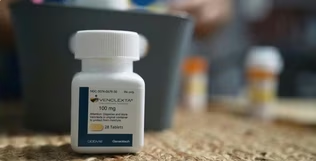
As drug costs rise, reduced coverage has deadly consequences
Video has Closed Captions
Clip: 12/21/2025 | 6m 46s | As medication costs rise, decreasing insurance coverage has deadly consequences (6m 46s)

Coast Guard ramps up oil tanker interceptions near Venezuela
Video has Closed Captions
Clip: 12/21/2025 | 5m 39s | U.S. Coast Guard ramps up oil tanker interceptions off Venezuelan coast (5m 39s)

A look at Christmas festivities, traditions around the world
Video has Closed Captions
Clip: 12/21/2025 | 3m 22s | A look at Christmas festivities and traditions around the world (3m 22s)
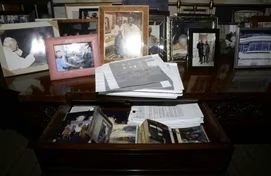
News Wrap: Trump photo missing from DOJ Epstein file release
Video has Closed Captions
Clip: 12/21/2025 | 2m 18s | News Wrap: Trump photo among missing Epstein files from Justice Department release (2m 18s)
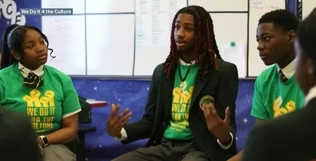
School program uses hip-hop to teach social-emotional skills
Video has Closed Captions
Clip: 12/21/2025 | 5m 44s | How a school program from Baltimore is using hip-hop to teach social-emotional skills (5m 44s)
Providing Support for PBS.org
Learn Moreabout PBS online sponsorship
- News and Public Affairs

FRONTLINE is investigative journalism that questions, explains and changes our world.

- News and Public Affairs

Amanpour and Company features conversations with leaders and decision makers.









Support for PBS provided by:
Major corporate funding for the PBS News Hour is provided by BDO, BNSF, Consumer Cellular, American Cruise Lines, and Raymond James. Funding for the PBS NewsHour Weekend is provided by...