
April 21, 2026 - Full Show
4/21/2026 | 26m 49sVideo has Closed Captions
Watch the April 21, 2026, full episode of "Chicago Tonight."
Meet the new leader of Chicago City Council’s powerful Zoning Committee. And after Artemis II, what does NASA have planned next?
Problems playing video? | Closed Captioning Feedback
Problems playing video? | Closed Captioning Feedback
Chicago Tonight is a local public television program presented by WTTW
WTTW video streaming support provided by members and sponsors.
April 21, 2026 - Full Show
4/21/2026 | 26m 49sVideo has Closed Captions
Meet the new leader of Chicago City Council’s powerful Zoning Committee. And after Artemis II, what does NASA have planned next?
Problems playing video? | Closed Captioning Feedback
How to Watch Chicago Tonight
Chicago Tonight is available to stream on pbs.org and the free PBS App, available on iPhone, Apple TV, Android TV, Android smartphones, Amazon Fire TV, Amazon Fire Tablet, Roku, Samsung Smart TV, and Vizio.

WTTW News Explains
In this Emmy Award-winning series, WTTW News tackles your questions — big and small — about life in the Chicago area. Our video animations guide you through local government, city history, public utilities and everything in between.Providing Support for PBS.org
Learn Moreabout PBS online sponsorship>> thanks for joining us on Chicago tonight.
I'm Brandis Friedman.
Here's what we're looking at.
We have a lot of work to do is a lot of people that want to build into city.
The city's new zoning committee chair joins us to discuss his powerful new position and his plans to address the backlog of developments waiting for approval.
And the artist who mission might be over.
But NASA's plans for export space still soaring.
A look at what to expect.
First off tonight.
>> The FBI is doubling the reward for anyone with information that helps investigators find a man they believe killed or shot and killed in Illinois.
National Guardsmen nearly 5 years ago.
The agency says it's now offering $50,000 in the search for 44 year-old Joseph Matos, who's been indicted on federal racketeering charges related to the killing but remains at large.
They believe he's involved in the killing of 19 year-old Chris Carter Hall Carbajal had graduated from National Guard training and was set to be stationed at a military base in Riverside.
Carbon Hall's family originally offered a $25,000 reward, but told WTTG your news at the time.
But detectives collected evidence and witness testimony.
But Cook County prosecutors declined to press charges citing insufficient evidence.
And executive order from Governor JB Pritzker seeks to limit state employees from using nonpublic information gained through their job but to place bets in the rapidly growing prediction markets, such markets like Polly Market how she allow users to bet on anything from sports to policy decisions.
The governor's office says they operate with little or no regulatory oversight or safeguards.
The U.S.
under the order no state employees can use knowledge gained from their official position to participate in the markets or event based contracts whether or not they profit sharing that information to help others with their bedding is also prohibited.
The Chicago Bulls are now in the market for a new head coach Hall of Fame coach Billy Donovan is resigning after 6 years at the helm.
He was expected to stay on after recent front-office shakeup in the organization wanted him to stay.
But now the coaches step down and let the still to be hired.
New off-court leadership team pickets on coach under Donovan.
The Bulls made the playoffs just once and recently traded much of the roster for future draft picks will Michael Reinsdorf thanks Donovan for his service with the team and blames a roster.
Construction for the team's struggles, not the coaching.
We meet the new leader of City Council's powerful zoning committee.
He joins us right after this.
>> Chicago tonight is made possible in part why the Alexander and John Nichols family.
The Pope Brothers Foundation.
And the support of these donors.
>> It's considered one of the most powerful positions in City Hall after months without a permanent leader City Council's committee on zoning, landmarks and building standards finally has a new chair.
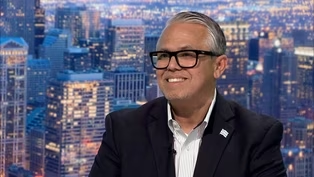
36 Ward Alderman Gilbert Villegas will lead the committee, putting him at the Centre decisions that shape everything from neighborhood housing to billion dollar developments.
Joining us now is the newly-appointed Zoning Committee chair.
36 word, Alderman Gilbert Villegas who represents parts of the northwest side like Belmont, Craig and Humble Park.
Welcome back.
Alderman, Congrats on the new position.
I appreciate.
Thank you, Brenda Famu back.
So you're stepping into the role.
It's been months of stalled meetings.
More than 100 proposals are still in limbo.
What's your plan to work through that backlog?
Well, we've already hit the ground running.
We've already scheduled to meetings for next month when a May 6 where we're here.
>> About 85 to 90% of those projects.
And my intention is to have a long meeting on that day in order to get these projects approved so that we can get people to work working.
Then on May 19th will have a another meeting that will deal with some of pay roll over projects as well as some tax amendment on ordinances that need to be that he be moved.
But yeah, this this we need to get things moving.
People are ready ready to get to work.
This is construction season.
Unfortunately, we don't enjoy the same whether it's California and Florida.
And so we have a the compressed construction season.
So we want to make sure that we're getting people I do want this position.
Look, this is something that this I've been in the construction industry, my whole professional career deputy director with the Department of Transportation, not-for-profit Trade Association read advocating infrastructure down to Springfield in DC and then also I was the chief of staff what's called the Capital Development Board, which is an agency that does a state agency that all the vertical construction in the state of Illinois.
So in essence, it was a question construction manager.
I lead the economic Capital Technology Development Committee as well as the chairman for the last 6 years and capital being part of the infrastructure.
So again, I know to get things done and looking forward getting it done for our colleagues.
It extension of work that you previously Are there specific types of projects, affordable housing, transit oriented neighborhood revitalization that you plan to prioritize first once you get going?
Yeah.
So it's we're going to be talking with our colleagues can find out what their what their priorities are.
We want to make sure that we're addressing.
>> The housing shortage that's there.
One of the big issues that we're seeing around supply and demand is just predictability of how big it projects completed.
And so one of the key things I want to do is meet with both developers and the outside attorneys as well as the internal government employees to figure out what is it that we need to do in order to speed up projects.
This is the perfect related technology on so that we would predictability.
I would imagine having each project having its own dashboard were those folks and some of those stakeholders have an opportunity look at that dashboard to find out where the rat in the process.
Again, this is right for taking out.
This is right for technology because already we have tons of boxes of paper and in 2026.
We gotta get rid of the paper, especially specifically around this committee.
Your previous leading role, the economic Capital Technology Development Committee that's been handed off to Alderman Derek Curtis.
>> No part of the deal that put you in the chair was the support of the Black caucus so that one of their members could take over there.
What does that say to you about the role of race and sort of politicking deal cutting in Chicago politics?
Well, I think I think and take a look at this as well.
I think that both Eric and I started 2015.
So we're we're we're not 3rd term and we didn't want to do is set a precedence around allowing freshman the ability to have >> powerful committees like zoning.
And so I think that in your and last and yeah, it's been in the role, yes Room, which which which he did a great job during his tenure there.
And he's the vice chair of the committee.
So we look, we're both going to work collectively to make sure that we get projects completed in the city, Chicago, but he was an opportunity to promote a colleague using our colleague of mine, who's in his 3rd term as well.
And we took them and we looked at it, do roll cause and we thought that was the best path forward as a result of my committee, my steps going to be helping and Eric as well to get to get his footings around that committee.
But we want to make sure that we're we're both can be successful, he's in charge of economic capital technology, infrastructure thing, which is called the capital Improvement plan.
That's in that committee.
And then I'll be with zoning.
So we're going to be doing a bunch of construction city.
Chicago.
There's also the of the little issue of Aldermanic prerogative.
Do you plan on honoring this this decades old tradition of aldermanic prerogative that gives all the people the final authority over the housing developments in their ward.
I think so I'm going to be setting up some meetings with see map as well as MPC.
So that's Chicago Metropolitan Agency for planning as well as the Metropolitan.
>> Planning Council.
I want I want to get some information around planning.
But what I see about automatic pride, it's more about educating people.
What we see is that once people talk about affordable housing, people out there.
That's all we don't want that in here and not understanding what affordable housing needs.
Listen, I grew up in late Pope's which a Chicago housing authority.
and as a result of that, again, living in living in public housing.
Give me a different view around what what working working people and what they're how they're struggling.
And we want to make sure that we're addressing every one of the affordability issue.
So going to be talking about affordable housing market rate, all types of development.
But what I really want to focus on is making sure that we have the ability to get things done.
Quicker.
The fact that we're taking months in some cases, years to get projects approved is really what's leading to the affordability issue.
Just not enough supply.
And as a result of that prices are You know, we talk about affordability and in whose impacted by the lack of affordability a lot on because there's been a finding by the U.S.
Department of Housing and Urban Development under former President Joe Biden that found.
>> That all the ramp aldermanic prerogative fuel segregation in Chicago, violating civil rights of black and Latino residents by limiting the creation of affordable housing.
How do you square aldermanic prerogative with that?
Well against is it's about education.
It's about having a discussion that's going to bring in the subject matter.
Experts around planning to figure out how we can educate my colleagues, but also the public around what affordable housing as a negative connotation right now.
And really frustrating because we take a look at what 60% of median household income is that some communities some cases at $60,000 for family of 2.
And we think about that.
I mean, that's little bit more than that.
Maybe $30.30, $1 an hour that someone's making, right.
So we need to we need to stop this whole stigma around negative stigma around former housing and educate people.
What affordable housing really means on that note, Chicago continues to face a housing shortage of how can zoning committee be used as a tool to fix to fix the affordable housing crisis?
In addition to what you just named.
I see the zoning committee as in up his economic development committee as well.
So we're gonna have the ability to spur economic development.
But what's really causing the affordability issue of supply and demand.
And what we need to do is make sure that we're getting projects done quicker.
I keep that this sizing technology because of the fact that government has been real slow to get on board technology.
Think about the fact that right now you can order groceries, track it on your phone, have affordable being delivered.
But yet if you get into the system, building system and to submit a permit, you can track it.
You're you Nicole people.
You're having to send emails to figure out where things are at.
And again, just no transparency.
So my goal is to really focus on cutting the red tape, getting projects completed quicker.
A lot for predictability of more transparency.
There's also major projects like the 78 side quantum Bally's Casino all in the works facing delays, public scrutiny.
>> What role do you plan on playing to move large-scale developments like that.
But while also ensuring community needs are taken into account, absolutely.
working closely with those those on our men and women that represent those areas.
This tonight we approved site quantum to my committee as well.
The foundry, which which is the previous Lincoln Yards.
78 with stadium.
I mean, these are projects that have been approved by City Council.
We're excited about those are projects that we need now imagine these are large scale projects that people that say, hey, we want to invest in Chicago, but we'll also hear from people that are a little bullish that are little bullish Chicago because of the fact that I'm certain little in Chicago because of the fact that just don't know what's going on there.
So we want to do is signal know Chicago's open for business.
We want to allow them to invest in the city, but then also do it in a way where again, is predictability about when these projects are going to take route.
Quickly, before we let you go, you previously been at odds with the mayor over issues like the budget, corporate head tax that he proposed plan on working with Mayor Johnson as well as the rest of city council on this.
And, you know, any time the city council, he's standing up and not being a rubber stamp.
It's good for taxpayers.
It's good for Jen Hawkins.
We're elected just like the mayor.
We have opinions and we should be able to voice those opinions.
So whenever the mayor has something that we can collaborate on looking forward collaborating, but if he's putting something forward and a bunch of us are not really accepting orders, we think is a different different opportunity to get it done.
We're going to make those opinions right.
Brand new zoning committee chair and 36 word Alderman Gover Ga Gus.
Thanks for joining us different to you.
Thank you.
Up next out of this world plans with a look at some of NASA's upcoming projects and missions.
Stay with us.
>> The new era of space exploration is under way.
Scientists, space enthusiasts and general skywatchers.
We're delighted earlier this month.
As for astronauts spent 10 days on a trip around the moon before splashing down in the Pacific Ocean.
But the end of the Artemis 2 mission is just the beginning for NASA's other goals.
Like building a moon base to studying faraway galaxies.
Joining us now, our Hunter Miller, a public observing educator at the Adler Planetarium Charles Mud, principal attorney at Mud Law who specializes in space law.
It is a thing.
And Allison Strong professor of physics and astronomy at Northwestern University and probably the coolest title space lawyer.
thanks to everyone for joining us.
We appreciate you.
A Hunter Miller.
What tells apartments to mission what did that accomplished?
So the goal of the Artemis 2 mission.
These are really very iterative missions that are all building towards a big future goal.
>> So this is the first test of the space launch system Orion spacecraft with humans in sides.
That was a really big step to take.
>> To move us towards an project S towards future missions, including winning astronauts on the >> What are the plans for Artemis 3, 4 and beyond.
So this has changed a little bit recently.
So Artemis 3 is now planned as a another test mission that will staying in Earth orbit rather than venturing to the moon.
This will allow them to have some future, some further tests with.
>> Docking with lunar landing module is being created by private corporations today.
So that is a test they thought was very important, an additional step that they wanted to add to this project with Artemis for being the full on return to the moon land astronauts on the lunar surface and that is currently being projected for as recent as 2028 very soon that feels like a tight timeline.
Flicked back to I mean, just tonight, unscientific mind coming up in a couple of years.
Basically, it is absolutely soon.
But, you know, when you have things like Artemis 2 that have launched their using very similar technology to return to the moon itself.
So, you know, it is a tight timeline will see if they can pull it off.
There's a lot of moving parts for these missions, but they always like to project, you know, the most positive outlooks.
See what we can do.
And I'm hopeful that they're gonna push to get us their Thank Charles.
What is international law say about what a country can do on the moon or anywhere in space?
Well, one of the most interesting things is that the moon and other celestial bodies as the terms happened to be in the Outer Space treaty and other documents.
>> Are the province of all humankind.
So no country, no party can claim ownership to a particular area of land of the moon.
>> What's interesting, though, the moon agreement, which was the last of the 5 treaties, space treaties was 1984, and the United States is not a party to the moon agreement.
And one of the main reasons for that is that the moon agreement went beyond the Outer Space treaty and so that nobody could on minerals or anything mined or extracted from the moon or celestial bodies.
And there are actually 4 countries, the Japan, UAE and Luxembourg that have laws contrary to the moon agreement and saying, yes, we things that we might.
And that is one of the future projects to mind from asteroids.
What is the U.S.
and maybe some of those other countries?
What's the country's rationed now?
>> For disagreeing with all the other countries that that have signed on to this.
And clarify one point and that most countries are not on the moon agreement.
I think there's probably less than 30 countries are actually signed on to the moon agreement than in comparison.
Really quickly.
The Artemis accords that the U.S.
has put forward has 62 countries.
Now a lot of your being actually signing on yesterday.
Welcome Lot B, a >> house.
And you are working on that early stages of a project with NASA that a look at potentially habitable worlds.
Tell us about that.
Yeah, that's right.
So it's a really exciting time for NASA science as well as space exploration and people are undoubtedly familiar with Hubble Space Telescope, James Webb, Space Telescope Roman, which will be launching in September.
But the one you're referring to is called habitable Worlds.
Observatory will be the next big NASA flagship.
And the idea here is to build essentially a super Hubble.
So it'll be bigger than Jamie team.
But at a look at UV wavelengths slay couple does and into the optical.
And so to let us look at Earth like planets around sun-like stars really for the first time and assess whether or not their habitable.
So it answer really for the first time this pressing question that we have, are we alone in the universe?
Are we alone in the universe?
Can we move to another planet if we mess this one up, there is no Planet but I think it's a you know, it's it's an age old question for humanity, I think.
And one that has eluded us because it's so technically challenging.
It requires an ultra stable telescope and a lot of technology that we're still developing.
So there's actually a lot of crossover between things in sort aerospace engineering and building the sort of next generation facilities like habitable worlds, uncertainty.
You mentioned the James Webb Space Telescope already out in space.
What are scientists learning from that cash?
It's really been a, you know, such a transformational facility and the world's best Christmas gifts, right?
And launched on Christmas Morning.
So I would say like the most interesting thing that we've learned is that everything is happening a lot earlier than we expected.
When we look at the very first galaxies, we see that there are a lot more mature than we expected.
So it's like looking back and expecting to see, you know, infants and seeing toddlers instead.
Now what we want to understand is what's driving this.
Why are galaxies forming so quickly and maybe this will help us understand, for example, the origin of our own galaxy, the Milky Way.
Hunter House, NASA working with private companies as they work towards possibly building a moon base.
So the role of private companies, it's going to take a few different roles along the process.
So the first step is going to be in future Artemis missions where >> they will be building components that will be used for landing astronauts on the lunar surface.
But looking ahead to the not NASA's plan for an extended moon base, you know, time on the moon for astronauts that will require many more landings.
Many more launches the NASA's capable of achieving by themselves just to get the materials required to construct these bases on them.
And so that is where private companies will really become very a central is in delivering these payloads to the lunar surface so that astronauts can go live on these bases and learn more about them there any ever.
Any criticisms concerns, conflicts about, you know, sort of the private involvement in what until what, the last 10, 20 years has for the most part been sort government's effort, right?
wasn't the original like back during the Space age.
>> That was all NASA.
All right.
It is a little bit of a new Also say that, you know, another thing and they're really pushing for with, you know, Artemis project is international cooperation as well.
This is really a mission for the entire world.
>> It's something that can only be accomplished with that cooperation because these are much more challenging goals than we have ever accomplished in space exploration in the past.
So I think it really just comes down to requiring the help of a lot of different folks to make these really big lofty goals possible.
And I think that really showcase is why we are choosing to return to the moon.
Now, you know, over 50 years after, you know, the last time we landed humans on all hands on deck.
Everybody to Charles.
What what are the legal questions, though, that pop up as private companies start to build a presence in space as well?
>> Well, one of the legal questions is our company under the same set of rules.
For example, tourist actually of somebody who watches the satellite.
Are they subject to the laws here on the United States?
And they are.
It's very clear that even under the Outer Space Treaty that alone the countries from which rocket or any object happens to be launch controls that that launch.
And if a U.S.
company, for example, launches a satellite, then that company in the satellite operations are still subject 2 United States law.
And that means to be very clear, because there's a limited amount of space, even though it's big.
There's a limited amount of space and the very south to and wants a low earth orbit.
So we need to make sure that the laws apply and that the country's the companies know that.
If that makes yes, it doesn't.
Following.
>> So then there's the president's budget request for NASA in 2027.
It would increase funding for space exploration but cut funding for science by 46% and cutting the total agency by 23%.
Allison, what might the U.S.
lose if these cuts are approved?
>> So I think it is very concerning obviously, I understand the desire to have a balanced but the science portfolio, if NASA has given us, I think some of the most amazing discoveries about our place in the universe over the last 30 years.
And it has helped the United States be leaders in astronomy and space science.
So we would lose a variety of telescopes.
I mean, we're familiar with the big names, but all of the telescope's, you know, there are dozens that work together to help us answer questions about stars, planets and galaxies.
>> And and ultimately what we would lose us, the ability to train future generations of scientists.
Most of the NASA money in addition to supporting missions goes towards training.
Scientists training students doing public outreach and all of that would be in jeopardy after physics in particular is actually slated to be cut by 65%.
And I don't know what you're supposed to do if a 3rd of the budget that you expected to certainly not meet these lofty goals that we've been talking Certainly not scientifically Fortunately Congress and I think most Americans are fully in support of supporting both science and space exploration.
And I did a quick calculation earlier.
I think the whole budget of NASA science plus space exploration works out to like one coffee per month per American.
And I think that's a pretty good Charles can investments and NASA had of those spur commercial innovation.
>> Well, you know, now, sir, kind of the impetus for all of the companies and everything that's come in the United States.
You know, they they kind of system from the research and the investment that's paid Bennett that made in Nassau.
And I think that that continued cooperation is necessary.
And SpaceX has had a huge part of working with now.
So to provide launches and actually move away from a time where the U.S.
had to rely on Russia to launch.
So there has been a commercial public-private partnership.
And I think that's going to continue into the Hunter couple of seconds left, whether it's the moon, faraway galaxies.
What do you think?
It's important to study space?
>> You know, I think it's a lot of reasons that it's important.
There's, of course, the science benefits, the cat out of exploring space.
Not just understanding of what our place in the universe.
>> But also a result and tons of other discoveries that are very useful in our day-to-day life.
Right.
But I think another element that's really important to me is the wonder that exploring space brings about I see that on people's faces every day of my work.
And that's something that I think space can provide.
That's really special.
And wd 40 built OK, I will have to leave it there 100 Miller Charles night out since Trump.
Thanks to all of Appreciate it.
Thank >> And that is our show for this Tuesday night.
Stay connected with our reporters and what they're working on by following us on Instagram at W T Tw Chicago and join us tomorrow at 5, 30 10 now for all of us here at Chicago Brandis Friedman, thank you for watching.
Stay healthy and safe and have a thing.
>> Closed captioning is made possible by Clifford and Clifford Law offices, Chicago, personal injury and wrongful death with more than 40 years
 New
NewAld. Gilbert Villegas on New Role as Zoning Committee Chair
Video has Closed Captions
It's considered one of the most powerful positions in City Hall. (9m 17s)
 New
NewWhat Comes After Artemis II? A Look at NASA's Plans
Video has Closed Captions
A new era of space exploration is underway. (11m 55s)
Providing Support for PBS.org
Learn Moreabout PBS online sponsorship
- News and Public Affairs

Top journalists deliver compelling original analysis of the hour's headlines.

- News and Public Affairs

FRONTLINE is investigative journalism that questions, explains and changes our world.











Support for PBS provided by:
Chicago Tonight is a local public television program presented by WTTW
WTTW video streaming support provided by members and sponsors.